
Editor’s note: These stories are in no particular order. Stories will be added to this list as they are published in Daily Report.

Hurricane Ida
Hurricane Ida came ashore as a Category 4 storm on August 29, 16 years to the day after Katrina’s landfall. While it did not deliver a direct hit to Baton Rouge, parts of the Capital Region were without power for more than a week. Many businesses and schools were closed, and drivers dealt with a gasoline shortage.
In New Orleans, the entire power grid was knocked offline, and many southeast Louisiana coastal communities were devastated. While federal help is forthcoming, the state still is not fully recovered from last year’s brutal hurricane season, and utility ratepayers will be paying for repairs for years to come. Read more about the storm’s impact.
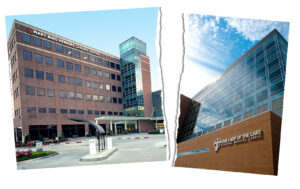
Mary Bird Perkins, OLOL split
Mary Bird Perkins Cancer Center and Our Lady of the Lake Regional Medical Center went through a messy divorce, ending a partnership that had lasted nearly a decade.
MBPCC will instead partner with Nashville-based OneOncology with the goal of growing into a comprehensive cancer care center that provides chemotherapy as well as radiation oncology. OLOL has announced plans to build its own $100 million cancer institute on the Lake’s campus, more or less adjacent to MBPCC.
The process of unwinding the complex partnership has been fraught with threats of litigation, patient care disruptions and public name calling, which is unusual in a health care marketplace that traditionally has been more collegial. The split also raises questions about whether there’s enough business to go around, especially with New Orleans-based Ochsner’s aggressive expansion in the Baton Rouge area. See a Business Report feature about the orgaizations’ divorce.

Amazon takes over former Cortana Mall site
Amazon’s plans to redevelop the former Cortana Mall site into a 3.5 million-square-foot fulfillment center was perhaps the year’s biggest economic development news.
The $200 million project is expected to have an economic impact of some $2.9 billion over the next 20 years and support more than 1,400 jobs with an annual payroll of some $53.8 million, according to the Baton Rouge Area Chamber. BRAC also predicts the project will generate $25.9 million in tax revenue in its first 10 years, including more than $12.2 million for East Baton Rouge public schools.
The center is scheduled for completion by August 2022. Commercial real estate agents say the planned facility already is sparking interest in nearby spaces.

LSU hires first Black president
The LSU Board of Supervisors in May selected University of South Carolina Provost William F. Tate IV to be LSU’s next president and the first Black leader in the university’s history. He moved quickly to reshuffle administrators, including naming Mark Bieger, his former chief of staff, to the newly created position of vice president of strategy.
Tate is tasked with getting a handle on how the university deals with sexual harassment and assault, which is the subject of lawsuits. His approach to dealing with COVID-19, including a vaccination-or-testing policy for students and faculty and a similar mandate for Tiger Stadium fans, which was weakly enforced and quickly ended, has at times been controversial.

Lurching economic recovery
Supporters hope the history-making selection of Tate, who has strong academic credentials, sends a message to the rest of the country that the beleaguered flagship is committed to change. On a semi-related note, when Brad Davis was named interim coach to lead the football team in the Texas Bowl, he became the first Black head football coach in the university’s history.
Last year, Louisiana was one of the first epicenters of the COVID-19 pandemic. But this year, with effective vaccines widely available and the coronavirus seemingly in retreat, life was starting to feel almost normal.
Then the highly contagious delta variant struck, setting new records for hospitalizations, spurring Gov. John Bel Edwards to temporarily reissue the state’s mask mandate, and creating fresh uncertainty in the Capital Region. But by fall, the vaccination rate was inching up (though it was still below the national average), and while the pandemic wasn’t over, the virus seemed back under control.
The recovery has been uneven, and workforce issues and supply chain snags continue to plague businesses. But by October, the Baton Rouge-area’s unemployment rate had fallen to 4.2%, the lowest since before the pandemic, and economist Loren Scott predicts the region will add almost 17,000 jobs next year. However, this could all change depending on what impact the omicron variant of the virus has on the Capital Region. Read more about the region’s recovery.

Flood insurance uncertainty
On Oct. 1, the federal government made major changes to the National Flood Insurance Program over howls of protest from members of Louisiana’s congressional delegation. The new system, which the Federal Emergency Management Agency calls Risk Rating 2.0, will increase flood insurance costs for many high-risk properties.
The feds hope the changes, which are supposed to be based on every building’s flood risk rather than its location on a map, will encourage developers and homebuyers to show more concern about flood risk.
But while some Louisiana property owners will save money, most are expected to pay more. And while increases are capped at 18% per year, those increases will compound over time. Agents and policymakers say they’re still in the dark about what the changes will mean for policyholders and the state’s economy. Read more about the flood insurance situation here.
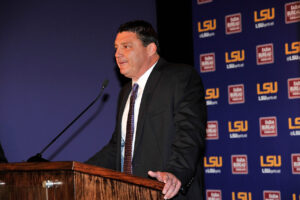
Orgeron’s fall from grace
Ed Orgeron was not LSU’s first (or second) choice to lead its football program after firing Les Miles. But he led the team to a national championship in 2019, putting together arguably the greatest season in college football history.
The Louisiana native leading LSU to a title was a national feel-good story. But the coach was accused of failing to report multiple sexual assaults, and his dating habits became internet fodder.
Ultimately, it was a string of ugly losses, not off-the-field scandals, that led LSU to fire Orgeron, buying out his contract for almost $17 million while allowing him to finish out the season. Equally stunning was Scott Woodward’s late-year surprise of getting Brian Kelly to leave Notre Dame to become LSU’s next football coach. Read more about Orgeron’s firing.

Half of business-backed tax overhaul passes
Voters in November approved a state constitutional amendment that triggers a complex tax swap, lowering income tax rates while giving up constitutional protection for the state’s tax break for federal income taxes paid.
The top individual income tax rate will be capped at 4.75%, compared to the current 6%. The five corporate tax brackets will be collapsed into three, with the top rate reduced from 8% to 7.5% for income over $150,000. The change also includes triggers for further tax cuts if the economy performs better than expected.
While most taxpayers are expected to save a little, the exchange is perhaps better understood as a simplification rather than a reduction. The state’s “sticker price” will more accurately reflect the actual tax burden, which advocates hope will make Louisiana more attractive to businesses and potential residents.
But a long-sought effort to streamline sales tax collection fell short at the polls. Local officials maintained their control over local tax collections, despite business advocates’ argument that the current system is too complex and confusing. The existing system, which critics say conflicts with the U.S. Supreme Court’s Wayfair ruling, will be challenged in court. Read more about the tax overhauls.
