

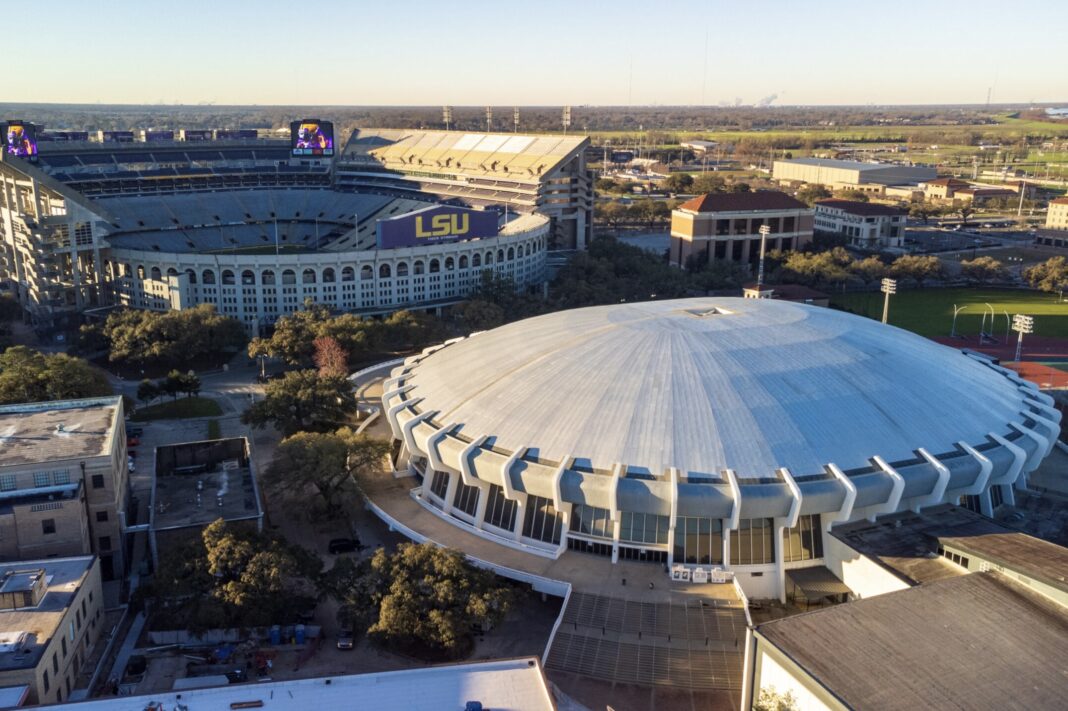
Those leading the charge on LSU’s proposed $428 million arena project remain confident that Oak View Group, the embattled firm in talks to develop the venue, is the right partner to move forward with.
In a meeting with Business Report’s editorial board on Wednesday, project leaders stressed that Oak View’s track record and resources far outweigh its recent controversies—the firm has developed seven private arenas and manages hundreds of high-profile venues around the globe—and that Oak View’s new leadership has moved quickly to steady the firm.
For context, Oak View’s CEO was indicted by the U.S. Department of Justice in July. The executive, Tim Leiweke, is accused of participating in a “bid-rigging scheme” tied to the development of the Moody Center in Austin, Texas. Oak View itself agreed to pay a $15 million fine for its alleged role in the scheme. Leiweke has stepped down as CEO, and Chris Granger, formerly Oak View’s president, has taken over his position.
Oak View is also at the center of a pending antitrust case against Ticketmaster, in which Oak View is described as a “pimp” for and “protector” of Ticketmaster parent company Live Nation.
Charles Landry, an attorney for the Tiger Athletic Foundation, said Oak View is “absolutely” still the developer of choice for the arena.
John Engquist, a member of the LSU Economic Development District’s board, said Oak View was just one of more than a dozen firms that project leaders initially reached out to about the arena, and Landry said it eventually became apparent that Oak View was the only one of those firms that could realistically handle a project of this size.
“The only proposal we got which was a robust proposal was OVG,” Landry said.
E.J. Kuiper, the president and CEO of the Franciscan Missionaries of Our Lady Health System, expressed his full confidence in Granger, Oak View’s new CEO, and pointed out that Oak View signed a corporate integrity agreement in the wake of Leiweke’s indictment. Our Lady of the Lake is in talks to pay up to $50 million for 10-year naming rights to the arena.
“[Granger] wants to make sure that he can prove to the world and to LSU and to this community that they are the right partner,” Kuiper said. “And I’m convinced they are.”
Engquist added that an outside consultant was brought in to evaluate the implications of Leiweke’s indictment and contended that the results of that evaluation speak volumes.
“Oak View did not lose an investor,” Engquist said. “They did not lose a client. … We’re very comfortable with Oak View, and we’re very comfortable with them because we’ve done the research and we’ve looked at the impact of this and what it means.”
Landry also suggested that Leiweke is innocent of the charges brought against him.
“It’s not bid rigging. … I’d bet a lot of money that he will never be convicted on what they charged him for. And that’s why he’s fighting it,” Landry said.
After news of Leiweke’s indictment broke, LSU said the future status of the arena project would be informed by a “due diligence review,” which is still ongoing. Even so, Landry said an agreement could go before the relevant governing bodies for approval within the next 12 to 16 weeks.
On Wednesday, the Metro Council unanimously voted to authorize two new taxes in LSU’s economic development district—specifically, a 1% sales and use tax and a 1% hotel occupancy tax. Those taxes will not help pay for the arena’s construction, which will be privately funded, but the arena’s developer may eventually receive the sales tax revenue generated on the 30-acre arena site itself as a means of recouping its investment and as an incentive to continue investing in the arena for years to come.
[crowdsignal poll=15959450]
