

Editor’s note: This story has been updated since its original publication to clarify language about Councilwoman Chauna Banks belief that the proposed residency requirement will advance to a public hearing at today’s council meeting.
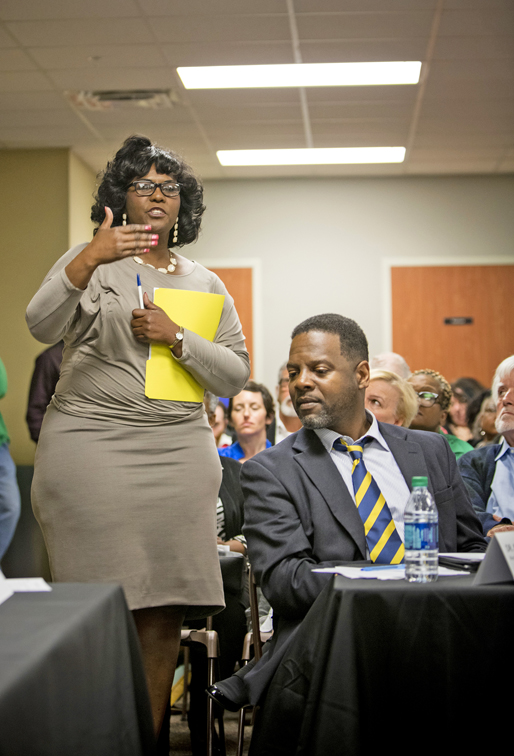
Metro Councilwoman Chauna Banks says she’s confident a controversial measure requiring Baton Rouge Police Department hires to live within East Baton Rouge Parish will advance to a public hearing at today’s council meeting.
The measure, which was blocked from being introduced at the council’s last meeting on July 27, will be up for debate and a possible vote today. Banks estimates that 80% of the feedback she’s received internally and externally has been in favor of the residency requirement, which the police department and its union oppose.
Banks argues the residency requirement is the needed foundation to advance community policing efforts, adding that millions in city-parish tax dollars are being spent on salaries for officers who live outside the parish and have little understanding of the communities they police.
“Anybody who votes against this, they’ve got to be checked,” Banks says. “We have to look at them and say, ‘Where is the hypocrisy in you?’”
Banks’ original proposal would have required that officers live within the Baton Rouge city limits. She has since amended it to require new hires, effective Jan. 1, to live within the parish. The requirement would not apply to any officer hired on or before Dec. 31.
Councilman John Delgado remains strongly opposed to the proposal, which he says artificially limits the police department’s recruitment pool and is poorly thought-out.
“I fully expect the item to fail,” says Delgado, adding that he expects a lot of public discussion on the issue today.
Delgado says the proposal diminishes the memory of Matthew Gerald, Brad Garafola and Montrell Jackson. The three local officers were shot and killed by a lone gunman in July; all of them lived in Livingston Parish.
“Were they worse police officers because they didn’t live in the city?” he asked. “I think it diminishes their memory to suggest that they would have been better police officers if they would have been from Baton Rouge. They still protected us.”
Banks says there’s no relationship between the fallen officers and the residency requirement.
“I think it’s very inappropriate for him, especially when it was so fresh with these families, to try to bring politics into something that was so horrific,” she says.
Baton Rouge’s proposed residency requirement surfaced after Alton Sterling, a 37-year-old black man, was shot and killed on July 5 during a confrontation with two Baton Rouge police officers. Two weeks later, six local law enforcement officers were shot and three of them were killed.
Delgado says there’s no evidence that any other municipalities have had success with residency requirements for police officers. Banks counters that there’s no evidence to suggest such proposals don’t work. And though the Baton Rouge department was reportedly 52 officers short of its allotment at the start of this month, Banks says it’s not impossible find qualified hires within the parish.
“That’s absolutely a myth and a weak excuse considering what the city has been through,” she says.
The council meets at 4 p.m. today on the ninth floor of City Hall, 222 St. Louis St. Also on the agenda is the introduction of a proposed 90-day building moratorium along a stretch of Highland Road between Siegen Lane and Perkins Road. The item was deleted from the agenda last month to correct ambiguous language.
—Alexandria Burris
