
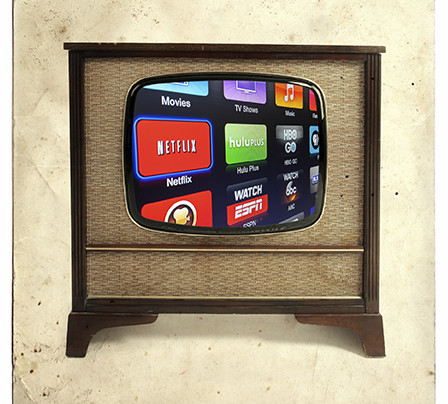
In her Introduction to TV Studies class last fall, Tulane University communication professor Mary Blue asked her students which shows they enjoy. The Mindy Project, Scandal and How to Get Away with Murder were among the favorites.
But when asked which network carries the shows, or on which nights the programs are broadcast, her students were stumped.
“They don’t even have a TV,” Blue says. “They have a computer.”
Television industry executives and observers have been talking about cord-cutters—people replacing their cable TV subscriptions with online options like Hulu and Netflix—for at least three years, she says. Her students’ responses may suggest another, perhaps scarier prospect for the cable business: An entire generation of consumers who see little reason to attach the cord in the first place.
A recent national survey by Tivo subsidiary Digitalsmiths found that 8.2% of former pay TV subscribers cut the “cord” with their cable or satellite provider in 2014—an increase of 1.3% over the previous year—and a whopping 45.2% said they reduced their service, which is sometimes called “cord shaving.”
Colleen Canale Levy oversees marketing throughout south Louisiana for Cox, the region’s dominant cable company. She acknowledges the growth of “over-the-top” video delivered through the Internet, particularly among young people. But for most local customers, she says, it’s not a “this or that” proposition. Those who like streaming movies with Netflix usually want to keep their cable subscriptions.
“This phenomenon is more about more choice,” she says. “Video consumption overall actually is growing. It’s more about new ways to access the content.”
Cox is privately owned, and as such does not release internal numbers. But Levy says its local video business is “very strong,” and since Cox also is an Internet provider, over-the-top media is a boost to its broadband business.
“We kind of win either way,” Levy says.
ALREADY OBSOLETE?
At this point in the evolution of the internet, there is no technical reason for “cable” television to exist. Beyond infrastructure, cable companies provide little, if any, value to the TV viewer, says Greg Satell, a consultant and former media executive and the purveyor of digitaltonto.com.
“The cable box is obsolete technology,” he says.
Satell says TV (like other industries) is moving away from hardware and into the cloud. Streaming services like Sling TV, which offers what amounts to a mini-cable package for $20 a month, already are eroding cable companies role as the most important gatekeeper of television content.
Even HBO, which is part of the same corporate monolith as Time Warner Cable and has a long, lucrative history with cable providers, recently began offering a streaming option that doesn’t require a cable subscription. But the flagship of prestige TV delivers HBO Now through partnerships, not directly to the consumer like Netflix.
“This really speaks to HBO’s reliance on internet service providers, who more and more are the same companies as the cable providers,” says Nathan Bragaw, an assistant professor of business at LSU who follows the shifting competitive dynamics of the television industry.
Even if cable TV is an outdated technology, the infrastructure cable companies own remains highly valuable and can be leveraged to provide Internet, home phone service (yes, millennials, home phones are still a thing), even home security. This versatility may put them in a stronger competitive position than their satellite-dish-reliant competitors, Bragaw says.
In Baton Rouge since 2009, the biggest rival to Cox has been AT&T U-verse, which also offers TV, Internet and phone service. U-verse works on an Internet Protocol platform, which the company says allows for more flexibility and content expansion to mobile devices. Content is downloaded from a hub that serves Baton Rouge and Houma/Thibodaux.
There is “definitely no buffering or anything like that,” says Cathy Miller, AT&T’s Baton Rouge area retail sales manager. AT&T hopes to purchase Direct TV, which would allow it to offer TV where U-verse is not available, she adds. Miller stresses mobility, but says U-verse isn’t really going after consumers who rely on internet-only platforms.
Many consumers want smaller bundles of channels, and many wish for “a la carte” cable; that is, the ability to choose the stations they actually watch. But expensive channels like ESPN often demand to be in the most popular tiers. A cable company has to negotiate for flexibility, and that can be challenging, says Levy, the Cox executive.
Sports programming is an important selling point for cable. Fans always watch the games they care about live, and would revolt if unreliable Internet service caused them to miss a few plays.
Sling TV is the first service to offer ESPN without a cable subscription. Yahoo recently acquired global streaming rights to a single early-morning NFL game this coming season, which isn’t a big deal. Unless it’s a sign that America’s most popular cultural institution is willing to shake up its relationships with traditional TV, in which case it’s a massive deal.
TV programming has decoupled from TV the appliance, and if Blue’s students are any indication, the distance between the two will only grow. It’s hard to predict where all this is going, although “more industry consolidation” is always a pretty good bet.
Blue reminds us that TV didn’t kill the movie business. The movie business adapted, and cable companies will do the same.
“In 10 years, things are going to look radically different,” she says.
