
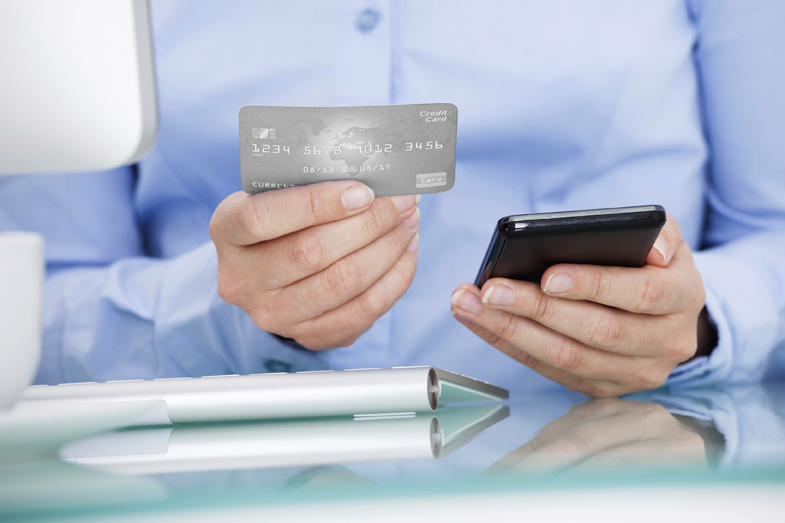
You want to check the balance of your savings account. Perhaps you need to pay your child’s college tuition or reimburse a colleague for your share of the check for lunch. If you’re like a rapidly growing segment of U.S. adults, you’ll reach for your mobile phone to conduct these and other banking transactions.
Mobile banking has increased substantially in recent years, according to the Federal Reserve Board, with more than half of smartphone users—and one-third of all mobile phone owners—using mobile banking in 2013.
The shift to digital is significantly impacting banking culture. U.S. banks, citing the growth of online banking, shuttered a record number of brick-and-mortar branches last year, nearly 1,600 nationwide, according to SNL Financial. A report by Aite Group analyst David Albertazzi projects thousands more banking offices will close by 2019.
Consider Bank of America, which closed 171 branches last year and now has just over 5,100 locations, down from 6,000 five years ago. But its mobile “active” bank accounts surged by 15% last year to 16.5 million.
Even so, Capital Region bankers caution the projected demise of traditional banking is greatly exaggerated.
A new report from the FDIC seems to bear that out: Between 1970 and 2014 the total number of banking offices grew nearly twice as fast as the U.S. population, and as of 2014, the density of banking offices per capita was higher than it had been at any point prior to 1977. Louisiana is one of 37 states that have experienced a net gain of bank offices since 1987.
“A few years ago, everyone thought branches would be dinosaurs,” says Danny Montelaro, South Louisiana area president for Regions Bank. “They said the same thing with telephone banking. Yet, more than 60 percent of our consumer banking customers and more than 85 percent of our business customers visit a branch at least once a month.” Instead, he says, “We find that most Regions customers use a multichannel approach to banking.” A nearby branch office remains a primary consideration when customers choose a bank, Montelaro adds.
In fact, banks in south Louisiana continue to add branches. For example, Gulf Coast Bank & Trust Co. has opened three in the past four years, while State Bank & Trust Co. is preparing to open a Covington branch in the coming months. An August 2014 American Bankers Association survey found visiting a branch—Americans’ second-most popular way to bank, behind Internet banking—had increased.
“Everyone is much more strategic about where we put that bricks-and-mortar branch,” says Andy Adler, executive vice president for State Bank & Trust. “There’s a segment of our client base that doesn’t want to come into a branch, but mobile banking is not going to satisfy everyone. For every person who demands mobile banking, there’s a person or a business who wants to come into a branch. There’s always going to be a need for bricks and mortar [branches].”
Mobile banking shares traits with online banking but differs in a key area: with mobile banking, a customer is not tied to a desktop computer or a laptop. Instead, consumers can conduct banking transactions wherever their mobile device can tap into an Internet connection.
This convenience, says Bennett Blackledge, branch sales and operations manager for Gulf Coast Bank & Trust, is mobile banking’s biggest asset. “As long as you have your phone on you, you can make a banking transaction from anywhere 24/7,” he says. The Federal Reserve found that the 93% of mobile banking users check an account balance or recent transactions, making this the most common use of mobile banking in 2013. Meanwhile, 57% of mobile banking users transfer money between their own accounts.
Other mobile banking services include paying bills and depositing checks through a mobile app. “It doesn’t matter if you’re in Istanbul or downtown Baton Rouge, you can make a deposit by taking a photo of a check with your phone,” Adler says. According to the Federal Reserve, the percentage of mobile banking users who deposited a check via their phone increased from 21% in 2012 to 38% in 2013. Further, 17% of all mobile phone owners made a mobile payment in 2013.
LIMITS ON MOBILE
Even so, customer demand for brick-and-mortar branches continues in part because some financial transactions—wealth management, capital expansion or credit extension—do not readily lend themselves to mobile, and often impersonal, transactions.
“Applying for a mortgage is close to impossible to pull off [using mobile banking], as is planning for retirement,” Montelaro says.
Moreover, such transactions depend greatly on relationships and trust, says Mark Ducoing, consumer banking executive for South Louisiana at Regions Bank. “We provide advice to our customers so they can make better financial decisions, and that involves relationships. It’s very difficult to do that with a mobile app.”
Consumers and business owners also often are leery of conducting transactions involving large sums of money without being able to look a banker in the eye.
“When you’re dealing with people’s money, that’s near and dear to the heart,” Adler says.
Bank representatives note that, despite predictions that mobile banking would cause traditional bank branches to become obsolete, very few solely Internet-based banks have experienced success. ABA cites banks’ investment in upgrading technology to improve customer service and efficiency as reasons why branches remain popular. Even large banks, such as JPMorgan Chase, continue to open new branches.
Laws and regulations also influence banking methods. “Tax law and the regulatory environment will continue to be more complicated,” Ducoing says. “And because of that, you’ll need face-to-face contact.” Under Patriot Act provisions, banks retain a responsibility for knowing their customers. Thus, limits to mobile banking may remain. For example, a bank is unlikely to accept a mobile deposit of a $2 million check, Adler says.
The Federal Reserve found in a 2013 survey that use of mobile banking correlates highly with age, with consumers between the ages of 18 and 29 accounting for about 39% of mobile banking users, despite making up just 21% of mobile phone users overall. Those age 60 and over accounted for only 7% of all mobile banking users but represented 25% of all mobile phone users.
Still, Adler says, customers’ preferences aren’t easily pinned down based solely on age. “We have just as many 50- to 60-year-olds who embrace technology and want mobile banking,” he says.
Ducoing adds that as people’s needs become more complex, their banking methods change.
As with any Internet-based transaction, security is a concern, particularly when money and personal information are involved. “The banking industry is all about security,” Adler says. “Our customers have to have full faith that we’re going to protect their assets.”
Blackledge, who teaches classes on preventing identity theft, says ironclad security measures are essential for mobile transactions. Yet mobile banking has actually made security more convenient to monitor. “With text alerts, you notice [fraudulent activity] so much sooner,” he says.
The banker recommends mobile users set up alerts that notify them when a transaction over a specific amount occurs or when an account balance falls below a specified amount. “If you use alerts, you can react much more quickly and not lose as much money,” he says.
As mobile banking increases in popularity, the challenge for banks is keeping up with diverse customer demands.
“It all comes back to what are the needs of the customers,” Montelaro says. “Mobile banking gives customers another convenient way to bank, but we’re not to a point where mobile banking is the only delivery method that a bank would offer. Branching and mobile strategies continue to evolve to serve customers how, when and where they want to be served.”
Shrinking locations
99,500
Number of FDIC-insured banking offices in 2009
94,725
Number of FDIC-insured banking offices in 2014
Change: -4.8%
