


Kellen Francis confesses to a “disgusting level of drive.”
Ten years ago, the self-described IT nerd and St. Charles Parish native began playing around with a tech startup concept that would help industrial companies drive efficiency and lower emissions through a proprietary AI platform.
Francis’ brainchild, CodeGig, is now a 10-employee company based at Nexus Louisiana. Along with IT services, the startup has created AI and machine learning capabilities intended to help Louisiana’s manufacturing sector better track and reduce emissions. The software shows companies how to lower carbon emissions using AI suggested rates, tracks carbon capture tax credits and automates reporting to the EPA in a matter of minutes.
Seed funding from Innovation Catalyst and proof of concept funding provided by LSU’s new Future Use of Energy in Louisiana, or FUEL, initiative helped CodeGig fully build out its software. That’s enabled the company to line up five strategic partnerships to date, with more in the pipeline, Francis says. His focus now is securing Series A funding.
Francis credits CodeGig’s progress to a robust entrepreneurial ecosystem in the Capital Region.
“It’s thriving,” he says. “This is not 10 or 15 years ago. The ecosystem is growing at a level that I don’t think people are realizing.”
Francis’ enthusiasm reflects what advocates have long hoped to see—a smoother on-ramp for startups with the potential for partnerships across the region’s numerous entrepreneurial hubs.
There’s more venture capital flowing through the state now, along with additional funding via LSU’s FUEL initiative and LED’s new Louisiana Growth Fund. Fresh leadership at Nexus Louisiana has shifted that entity’s focus to be laser focused on tech entrepreneurs. And LSU Innovation, the historic hub for startups in the region, is in the midst of finding new ways to improve the flow between startups and university resources.
“I think we’re going to redefine what [LSU] Innovation means,” says Greg Trahan, assistant vice president of economic development and acting director of innovation and technology commercialization. “I think it’s going to be much more tightly coupled to economic development, and entrepreneurs are going to have much better access to the entirety of the research enterprise.”
Silos and staffing woes
For years, the Capital Region’s climate for entrepreneurs has been successful but fractured, with key components like the Louisiana Technology Park, now Nexus Louisiana, and LSU Innovation’s Louisiana Business & Technology Center incubating scores of new companies. The same organizations were also criticized for siloed operations.
An effective realignment happened in 2021 when then-LSU Associate Vice President for Research Andrew Maas led a new organizational structure for the university’s 200-acre LSU Innovation Park that helped streamline the experience for both entrepreneurs and faculty inventors.
Its programs—the Louisiana Business & Technology Center, Louisiana Technology Transfer Office, the statewide LSU-based Small Business Development Center and the Office of Innovation & Technology Commercialization—were brought under a new umbrella called the Office of Innovation and Ecosystem Development.
Maas, who is also credited with overhauling LSU’s tech transfer programs, left the university in January to become the assistant vice president for technology transfer at the University of Texas at Austin. In fiscal year 2023, UT Austin spent $1.04 billion on research. By comparison, LSU spent $488 million. LSU has yet to replace Maas due to a hiring freeze. Since his departure, it has been working on an internal restructure to facilitate between startups and university units, Trahan says.
“The good news is that, as the flagship institution and as a research institution, the breadth and the scale of what we do and what we have is wild,” Trahan says. “I think when people come inside the wall, they’re like, ‘I cannot believe how much is available.’”
But connecting the dots has been a prevailing challenge, Trahan says. He’s currently working with associate director of entrepreneurial services Jason Boudreaux to improve systems that match entrepreneurs to the right resource.
“The partnership with LSU has to be the competitive differentiator,” Trahan says. “My version of success is that companies that are built out at LSU will have a higher valuation and subsequent investment.”
New day at Nexus
In February, Nexus announced the hiring of Tony Zanders, founder and CEO of the Baton Rouge-based library technology company Skilltype, which he grew to more than $4.2 million in v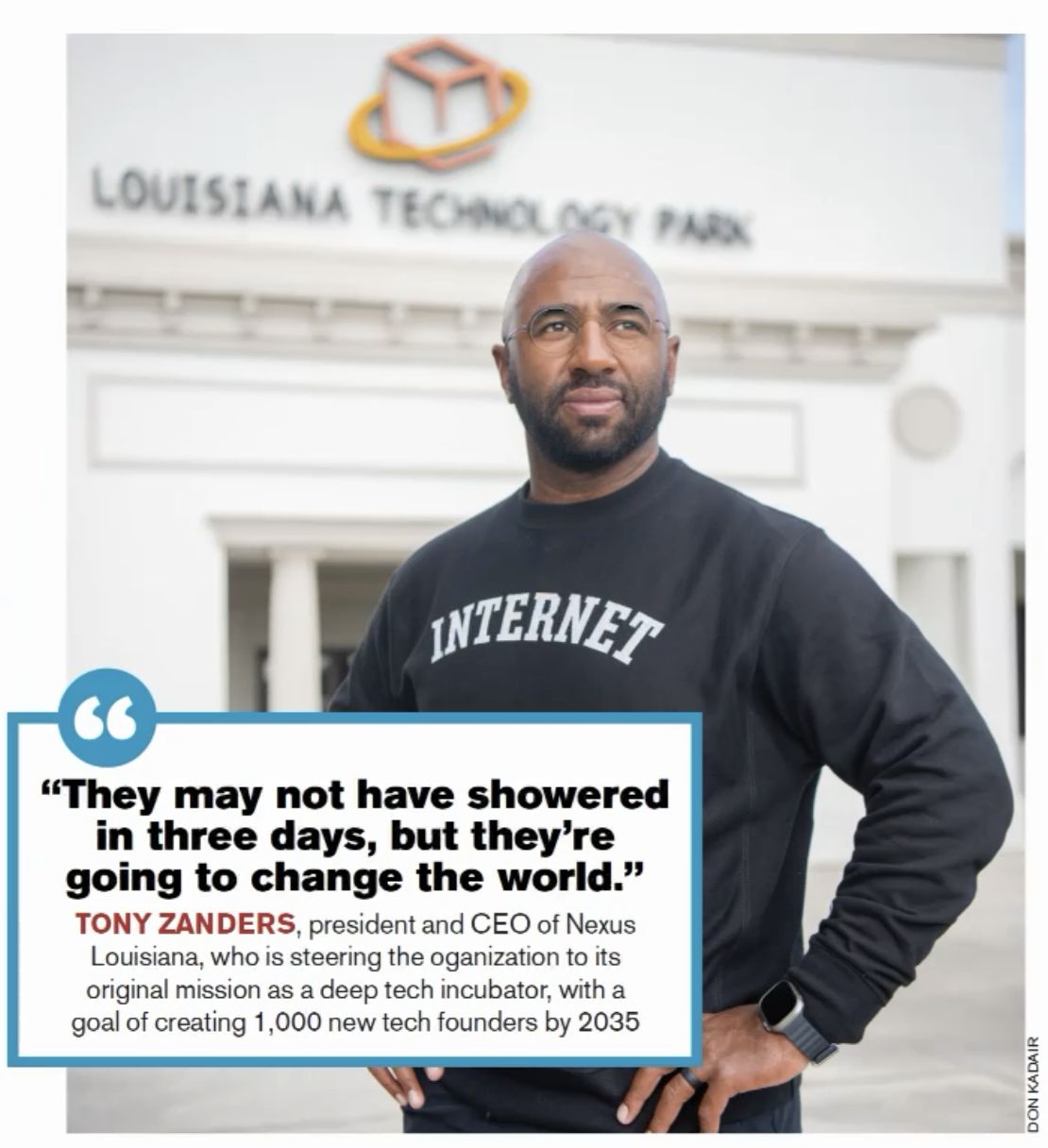 enture capital funding. Nexus board chair Anita Byrne says the hiring of Zanders signals the dawn of a new era at Nexus, one that returns the organization to its original mission as a deep tech incubator.
“The kind of collaboration with stakeholders and collaboration with partners that Tony is pushing for, and the alignment with the original goals, is really exciting,” Byrne says. “What I want for the Capital Region and our state is to have an asset like Nexus firing on all cylinders.”
A New Orleans native who worked in Silicon Valley, Zanders says he’s focused on fulfilling Nexus’ original goal of growing tech-enabled companies. He has set an ambitious goal for Nexus to create 1,000 tech founders by 2035.
Zanders called for the elimination of the long-standing Baton Rouge Entrepreneurship Week and PitchBR events, which had attracted a diverse array of startups. Instead, Nexus hosted its first statewide Technology Cup in June at the Water Campus, an event designed to signal Nexus’ singular role as a tech catalyst, Zanders says. Its judges hailed from MIT, Amazon, Block Inc., Arix Technologies and Vinformatix.
“When you think about how new technology is created and when you look at Silicon Valley, they don’t have pitch competitions,” Zanders says. “It’s not salespeople in suits with slick Power Point decks. It’s a bunch of totally awkward, introverted people who can spend hours staring at a computer, writing code. They may not have showered in three days, but they’re going to change the world.”
Removing barriers for ambitious techies and building a community that supports them is top of mind for the organization, the Nexus executive says.
“We have them all around,” Zanders says. “These are people who don’t wake up in the morning and say, ‘Hey, I’m an entrepreneur,’ but they’re passionate about their technical expertise. We need to create a community that supports them so they don’t leave and go to Houston or Atlanta.”
Byrne says Nexus’ anticipated relocation in 2026 from its longtime home in Bon Carre Business Center to downtown will help further attract and support a new generation of founders.
FUELed up
While tech is Nexus’ focus, energy is top of mind at FUEL, a multipartner program that sprang from LSU’s landmark $160 million National Science Foundation grant. FUEL’s technology commercialization program awards proof-of-concept funding to early-stage companies.
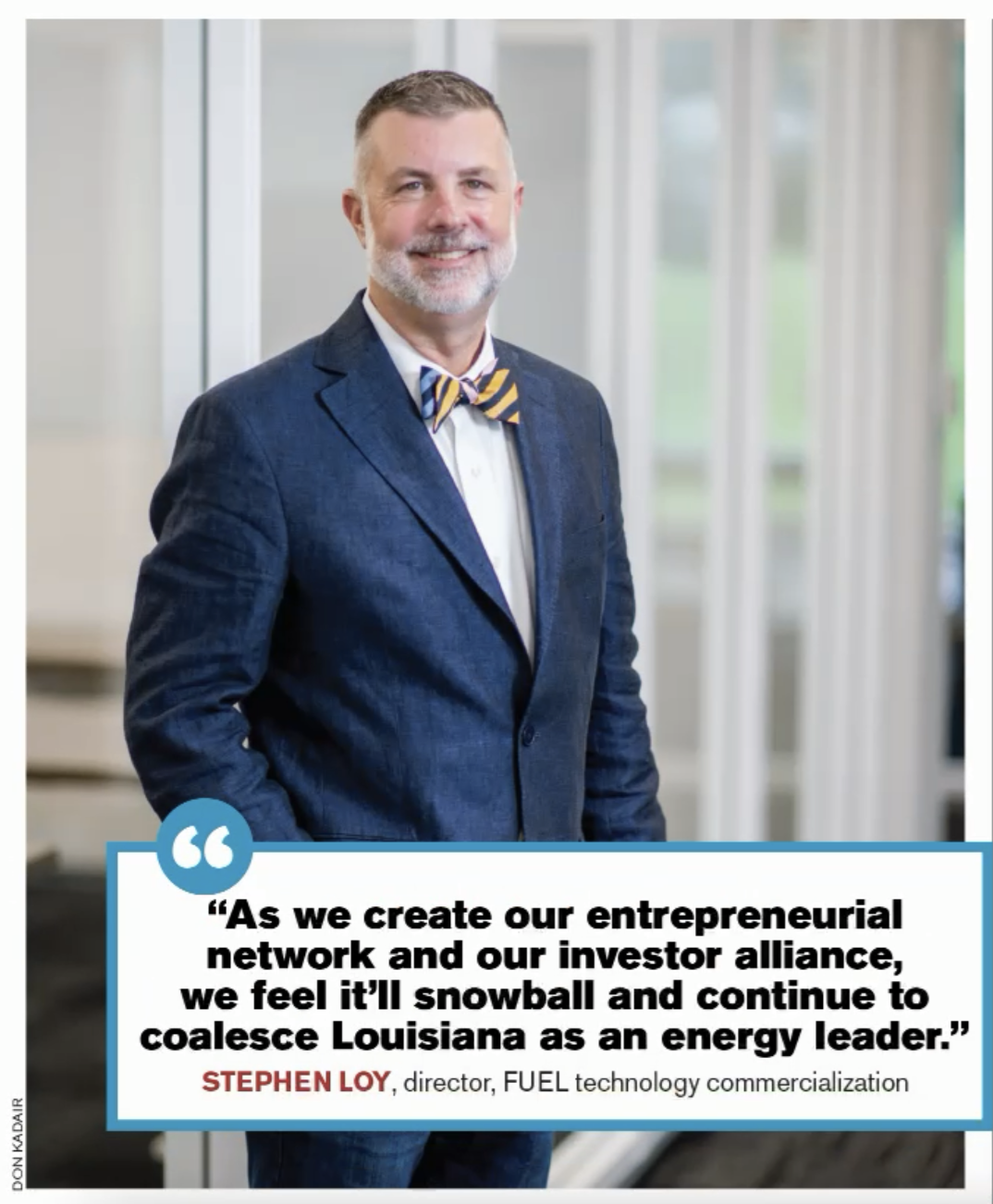 The organization is working with Nexus, LSU Innovation, the Louisiana Small Business Development Center at LSU and others to support entrepreneurs in a way that feels different from several years ago, says FUEL technology commercialization director Stephen Loy.
“Once upon a time, it was like if one entity had succeeded the other would fail, but now we share entrepreneurs,” says Loy, former executive director at Nexus. “Entrepreneurs aren’t successful because of one person or one organization. I think we always knew that, but now we’re practicing it and that’s the exciting part.”
Francis’ CodeGig, along with Louisiana Tech University, ApplicaRAD Inc., Encore CO2 and Cavendish Energy, received a combined $900,000 in first-round investment from FUEL’s inaugural proof-of-concept grants.
Loy says the goal is to increase the number of companies awarded by 20% to 50% year over year. He’s looking to outside investors for help.
“As we create our entrepreneurial network and our investor alliance, we feel it’ll snowball and continue to coalesce Louisiana as an energy leader,” Loy says. “We need more investors here in the state, and we need more investors outside the state to be interested in what’s happening here.”
 The state’s entrepreneurial ecosystem got another boost in February when Louisiana Economic Development announced the launch of a new division called Louisiana Innovation, or LA.IO, intended to create high-growth tech-enabled startups. The program also includes the $50 million Louisiana Growth Fund, intended to help entrepreneurs create or scale new companies. According to LED, LA.IO’s nonprofit Louisiana Institute for Artificial Intelligence will be supporting new and existing businesses with new AI tools.
“Successfully positioning Louisiana to win demands that we not only attract new businesses, but grow new businesses from the ground up,” LED Secretary Susan Bourgeois says. “Louisiana Innovation is dedicated to working with startups as well as existing companies to grow Louisiana’s innovation economy.”
Citing Meta’s $10 billion Richland Parish data center project as proof positive that a focus on innovation is the right strategy for the state, Bourgeois says the strategy is this: “We are redefining the Louisiana opportunity by investing in the next industrial revolution.”
Zanders predicts Louisiana Innovation will have major implications for the entrepreneur ecosystem as a whole. “I think it’s amazing,” he confides. “I think it’s going to be sort of a cortisone shot for our ecosystem.”
Related Story: LSU’s Foodii program fuels Louisiana’s food entrepreneurs
