
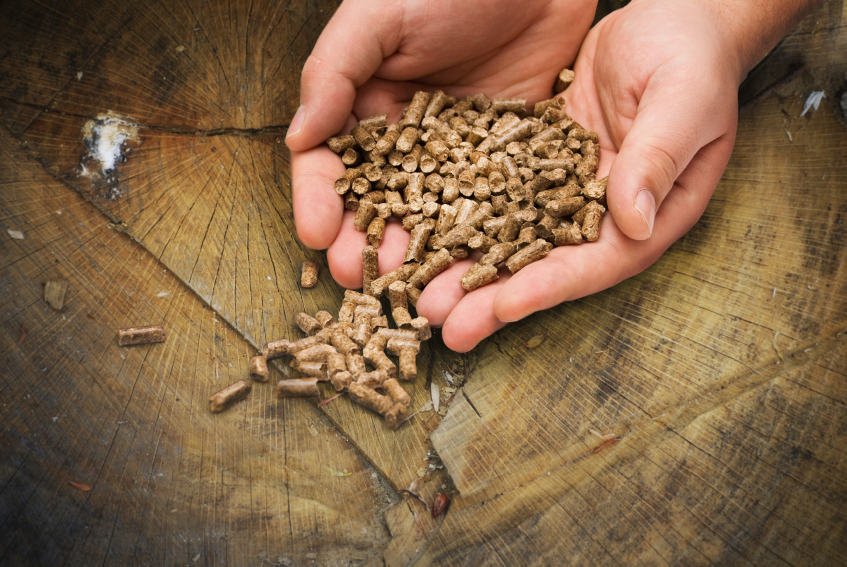
If you cross the Mississippi River bridge between Baton Rouge and Port Allen, you’ll notice two large white domes on the west side. Depending on the day and time, those domes could be empty, or they could each be filled with up to 30,000 tons of wood pellets.
The domes are one of three projects owned by one company and subsidized by governments on both sides of the Atlantic Ocean. While not everyone agrees, supporters say the effort is a win-win, helping to protect the planet from climate change while providing a new market for trees grown in Louisiana and Mississippi.
Here’s the gist: The Drax Group owns the largest power station in the United Kingdom, producing about 7% to 8% of the nation’s electricity. In response to a European Union directive to get more energy from renewable sources, the U.K. is helping to fund the station’s partial transition from coal to wood harvested in North America. By one estimate, Drax received at least £340 million in subsidies last year alone.
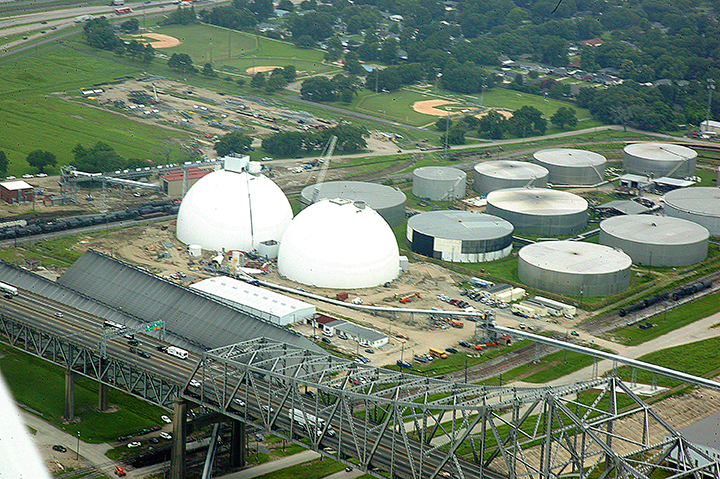
To meet their wood pellet needs, Drax Biomass built two production plants. The company says each can produce 450,000 tons of pellets per year. One of the plants, Morehouse BioEnergy, is in Bastrop, while the other, Amite BioEnergy, is in Gloster, Miss. The white domes next to the Port of Greater Baton Rouge are part of Drax’s Baton Rouge Transit Facility, where the pellets will be stored and loaded onto ships for export to the U.K.
Drax is investing more than $120 million in Louisiana while creating 47 direct jobs in Bastrop and 16 in Port Allen, according to LED. The company got $1.7 million from the state that won’t have to be repaid if it meets its payroll obligations. The Louisiana Economic Development Corporation, which reviews and administers several taxpayer-backed financial assistance programs, loaned the company an additional $500,000. The projects also benefit from the state’s Quality Jobs and Industrial Tax Exemption programs.
Buck Vandersteen, who directs the Louisiana Forestry Association, says wood pellets are an important new opportunity for the state’s forestry industry. He says landowners in the state are growing more trees than they harvest. But when the economy crashed several years ago, they were left with fewer markets.
Drax’s plant in Bastrop will help replace demand for wood from a now-shuttered International Paper mill. A company called German Pellets, while not as far along as Drax, is building a similar plant in Urania that should help pick up the slack left by the closure of another mill in Pineville, Vandersteen says. He says another project near the Natchitoches Parish Port may be announced soon.
Drax says it buys wood that has been sustainably grown.
“We source from commercial forests,” says Drax spokesman Andrew Brown. “This is land that has been planted predominantly to create a saw log to create timber for construction.”
The company can’t compete on price for the best wood; instead, it uses leftovers such as the sides of logs, sawmill residue and branches, Brown says. Vandersteen says pine has been the tree of choice.
CARBON-NEUTRAL?
All of this is predicated on the idea that burning trees for fuel essentially is carbon-neutral, since in sustainable forestry, new trees are planted that can absorb the CO2 released when the older wood is burned. While some carbon is produced in processing and shipping, using wood pellets for fuel is up to 90% less carbon-intensive than coal, Brown says.
The Dogwood Alliance, an environmental group, contends that burning trees for electricity actually accelerates climate change while destroying forests.
“It’s really silly to burn the things that are supposed to be saving us from climate change to save us from climate change,” says Scot Quaranda, the group’s spokesman. He says a recent Baton Rouge meeting of his organization’s Save Our Southern Forests tour drew about 50 people, including retired Lt. Gen. Russel Honore, who in recent years has stumped for environmental causes. [Honore for several months flirted with running for governor before announcing July 1 that he would not run for the office.]
Quaranda notes that pellet plants are highly mechanized and support far fewer jobs than the mills they ostensibly replace. He says the amount of wood pellets being exported from the United States has grown from a few thousand tons in 2009 to 4.4 million tons in 2014, and says about 20 pellet mills are proposed throughout the South.
And while he can’t speak to Drax’s sourcing in Louisiana, he says one of the company’s suppliers in North Carolina was found to be using whole trees from an irreplaceable wetland forest.
He says recent doubts about the science justifying wood pellet conversion could lead the E.U. to rethink its policies.
“If the finicky European market changes and cuts those subsidies, we’re going to leave the South with a whole bunch of stranded assets,” Quaranda says.
Brown says Drax’s biomass incentives from the U.K. government are locked in through 2027.
“We simply wouldn’t be able to justify the investments without a decent time commitment from the authorities,” Brown says, adding that replacing coal with biomass is cheaper than some other alternatives such as offshore wind farms.
Jerry Hingle is president/CEO of International Trade Associates, a New Orleans-based consultancy that helps businesses and trade associations reach foreign markets. Forestry and lumber are among the industries he serves, and he says American forestry has been on a “strong bull run” of softwood exports over the past five years.
Hingle says he doesn’t expect the U.K. will change its policies promoting wood pellets as a coal substitute any time soon. But unless more countries adopt similar programs, he doesn’t think the wood pellet market will grow into a “huge opportunity” for Louisiana forestry.
