
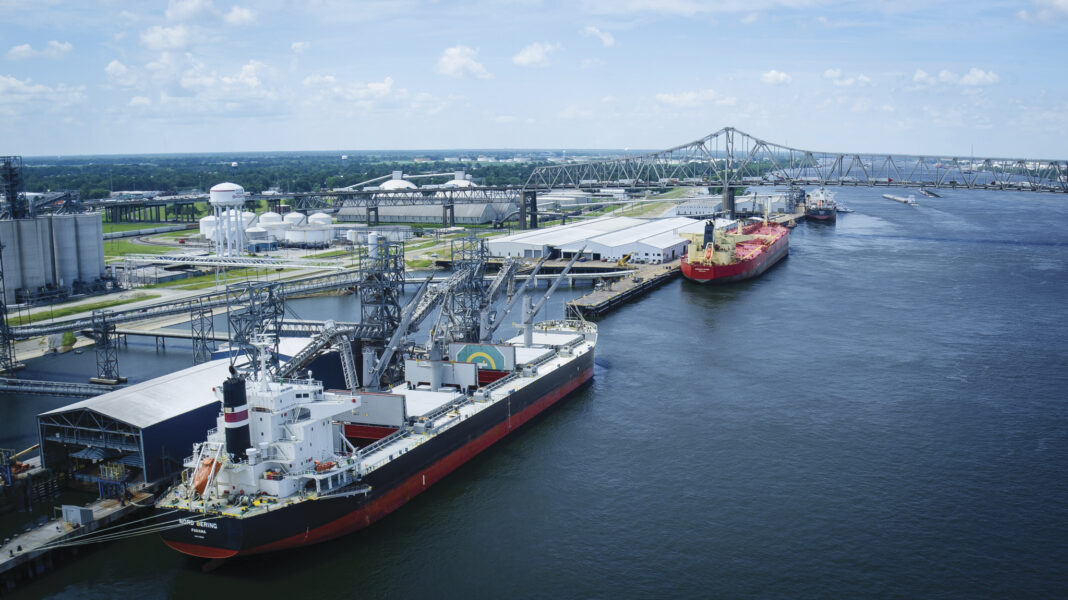
Infrastructure improvements, a deepening river draft and inter-port collaborations are setting a new, and potentially transformational, course for the Port of Greater Baton Rouge.
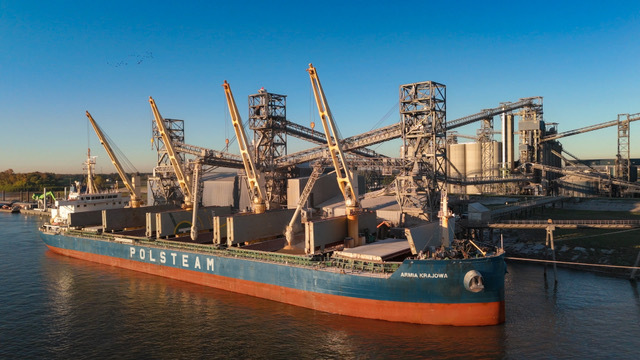
The port has always been closely aligned with the U.S. agricultural market. Given its rail infrastructure and barge accessibility, it’s ideally suited as a destination for outbound shipments of grain, oil seeds, sugar, wood pellets and sometimes rice. The port’s grain elevator— maintained and operated by Louis Dreyfus Co.—is one of its largest tenants, moving between 5 and 6 million tons of exported grain and oil seed per year.
They’re continuing to expand and improve in that space, currently working with Dreyfus to begin accepting crushed soybean meal by rail and barge. “It will enable the rail delivery of about 1 million plus tons per year of the product,” says Jay Hardman, port executive director.
“That fits well with the elevator’s utilization cycle … we get a big surge of product during the harvest season for corn and soybeans, then we hit a lull. That’s just when the crushed soybeans (exported as animal feed) begin to move.”
The overall cost of the infrastructure improvements is nearly $30 million, to be used to improve conveyance equipment and rail dumps (where the rail cars are emptied). The project is currently in the early design phase, with an anticipated completion in late 2027.
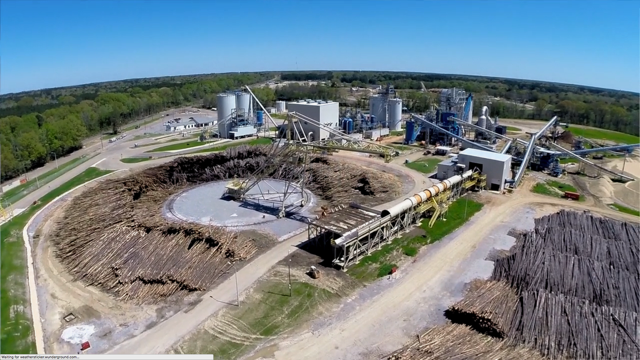
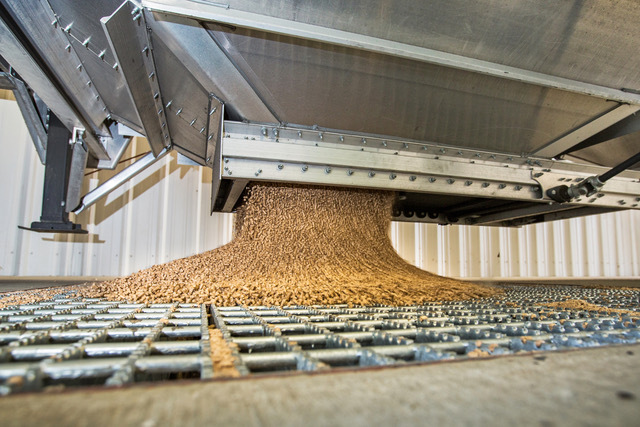
Additionally, Drax Biomass continues to increase its wood pellet tonnage and is currently shipping pellets from several pellet mills in Louisiana, Mississippi and Arkansas to the U.K. They heavily depend upon the port’s rail chambering yard, which can handle up to three large trains of 80 railcars each, with expansion capabilities to six trains of 110 cars each.
FORGING A PARTNERSHIP
“In 2025, the port began partnering with the lower Mississippi River’s four other deepwater ports to develop a collaborative marketing strategy aimed at increasing international trade, driving economic growth and attracting new business.”
Until now, there has never been a formalized, structured agreement among all five of the port systems. The rollout of the plan will be finalized this spring. “The five ports have completed a cargo analysis to identify how products/cargoes are moving into and out of the state,” Hardman says. “Dovetailing that information into a unified and coordinated marketing effort, we’re looking at creating a more consistent, unified voice for the Lower Mississippi River that will attract future investments and additional jobs.”
The Port of Greater Baton Rouge has never shied away from collaboration. For several years now, it has worked with Port NOLA to provide a “container-on-barge” service that shuttles containers via the river to reduce truck traffic, lower emissions and provide cost-effective transport for Louisiana’s industrial, chemical and agricultural exports.
And more recently, the port entered into a cooperative endeavor agreement that enables the Port of South Louisiana to work directly with Hyundai Steel in Ascension Parish (which falls within the Port of GBR’s jurisdiction) in the development of their dock system. That’s significant, since the dock will facilitate the offloading of approximately 4 million tons per year of iron ore to support the $5.8 billion facility’s production of 3 million tons of ultra-low-carbon steel sheets.
LOOKING AHEAD
Enhancing river functionality is another primary goal. Case in point— a new air draft monitoring device on the I-10 bridge over the Mississippi River is already improving the flow of river traffic, as it instantaneously provides distance readings between the water and bridge. The data from the solar-powered device is easily accessible through a computer link. “Before, they looked at river gauges, then performed a mathematical calculation to estimate the draft,” he adds. “Now, it tells them instantly what they need to know with no guesswork.”
Additionally, the Corps of Engineers’ continued deepening project of the river to 50 feet up to Baton Rouge will have an enormous economic impact, as it will enable area industrial companies and port tenants to substantially increase shipping capacities. “Anyone who uses a deep draft ship is limited to a draft of about 45 feet,” Hardman says. “That’s a particular problem during low water events. A deeper draft will give them an improved economic advantage with increased tonnage per ship.”
Hardman says everything’s coming together at the perfect time. “Moving forward,” he says, “we plan to continue leveraging our strengths to attract new investments for the benefit of both Baton Rouge and the state at large.”
CONNECT WITH US
Top Executives: Jay Hardman, P.E., Executive Director
Address: 2425 Ernest Wilson Dr., Port Allen, LA 70767
Phone: 225.342.1660
Website: portgbr.com
