 GET DAILY REPORT FREE


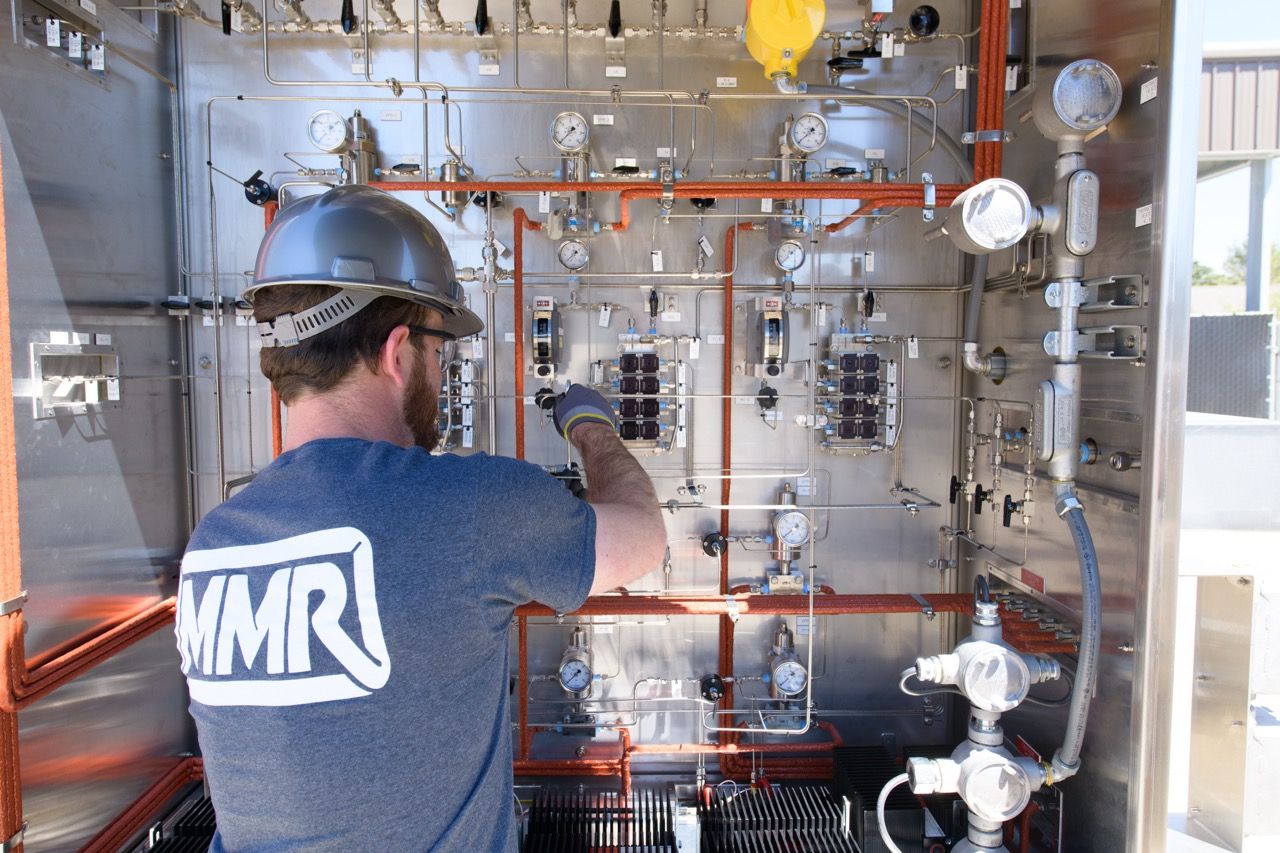
The infrastructure that powers modern industry is largely invisible; it’s buried in conduit, tucked behind control panels, threaded through the walls of refineries and data centers and chemical plants. Building that infrastructure, and keeping it running, is the unsung work that makes everything else possible. It’s also MMR Group’s specialty.
Founded in Baton Rouge by James “Pepper” Rutland, MMR designs, installs, tests and maintains the electrical and instrumentation systems on which industrial facilities depend: the wiring, sensors, control panels, power distribution networks, communications systems and safety infrastructure that keep refineries, chemical plants, power generation facilities and data centers running.
CONNECT WITH US
Top Executives: James “Pepper” Rutland, President & CEO; Donnie Fairbanks, CFO; Jeramiah Blum and Jonathan Bruser, Executive Vice Presidents
Address: 15961 Airline Highway, Baton Rouge, LA, 70817
Phone: 225.756.5090
Website: mmrgrp.com
“We’re the largest open-shop electrical and instrumentation contractor in America,” says James “Pepper” Rutland, president and CEO. “We’re involved in building some of the most complex facilities in America and 40 countries in the world. When your lights don’t come on, don’t call us—call Entergy, and they’ll call us.”
MMR employs roughly 10,000 people nationwide, operates 30 offices and generates billions in annual revenue. Yet the company has never moved its headquarters from Baton Rouge. Rutland, a Baton Rouge native and LSU graduate, has never lived anywhere else. “I like the culture, the people, the downright honesty,” he says. “It’s a big little town, small enough to be big and just big enough to be small.”
Over the past eight years, MMR entered the data center market and has since completed dozens of data center and AI facility projects all over the country. This has also led to the development of MMR’s Modular Systems division housed in a 200,000-square-foot facility in Lafayette.
“We didn’t abandon anything to get into data centers,” Rutland says. “We built around our core, turning client challenges into capabilities.” That core remains as strong as ever, even as new sectors add substantial revenue to the portfolio. With massive AI infrastructure builds, LNG export expansion and advanced manufacturing all accelerating at once, Rutland believes 2026 will surpass 2025, which was already the company’s largest year on record.
FROM THE PRESIDENT & CEO:
”I was the captain of the football team my senior year at LSU. In that role, I never learned anything from success. I learned everything from failure. When the outcome isn’t what you want, you figure out how to change it. You take responsibility, you step to the front, and you do the work. You lead by example, including the things nobody wants to do. That’s sometimes the job. Most people respect that. That’s been our creed and our motto for a very long time.”
JAMES ‘PEPPER’ RUTLAND
With roughly 3,000 employees in Louisiana alone, MMR is one of the state’s most significant private employers. Rutland has made workforce development a personal mission. MMR University, the company’s internal training program, takes in interns and combines academic coursework with hands-on business education. The company recruits heavily from LSU and Southeastern Louisiana University, among others, and has committed philanthropic support toward a new construction management building at LSU. “A lot of our staff come from this area,” Rutland says. “We believe strongly in giving back to the community that has been good to us.”
That commitment extends beyond workforce. MMR is a longtime sponsor of the American Cancer Society’s annual gala and LSU athletics; it’s a company where community investment is woven into the culture. Inside its Baton Rouge campus, a large employee gym and quarterly company events reflect Rutland’s conviction that a happy, supported workforce is the foundation of everything else. “We’re in the people business,” he says. “If our workforce isn’t any good, then we aren’t any good.”
Rutland sees a convergence of forces positioning Louisiana for an unprecedented run. The state’s abundant energy resources make it a natural hub for the power-hungry data centers and AI facilities now reshaping the national economy. LNG export infrastructure continues to expand along the Gulf. Advanced manufacturing is accelerating. And the electrical workforce shortage that accompanies all of it represents both a challenge and an opportunity for a company that has spent 35 years building that talent pipeline.
“This is a new era, a new age, a new technology,” Rutland says. “The industries are going to come, and the people who manage those industries are going to come with them.” For a privately held company that bet on Baton Rouge decades ago, the next chapter looks bigger than anything that came before it.