

It has been a decade since community leaders and local and state government officials gathered at the old municipal dock overlooking the Mississippi River to announce plans for The Water Campus—a project intended to serve as a world-class research hub for coastal restoration and water management solutions.
Born from talks that started following the devastation of Hurricane Katrina, the Water Campus stretches some 30 acres, from the riverfront toward Nicholson Drive. At the time of the development’s announcement, leaders billed the research campus as the future economic and cultural southern anchor of downtown Baton Rouge.
Today, the $100 million first phase of the campus is complete, drawing researchers and scientists, state officials, and students alike, who say the access the campus provides to like-minded neighbors helps foster creative collaboration in tackling the state’s most daunting coastal restoration and water management quandaries.
The project was a win-win for the city-parish, LSU and BRAF, says Christel Slaughter, board chair for both the Wilbur Marvin Foundation and Commercial Properties Realty Trust, BRAF’s real estate development arm. The Water Campus has been billed as the brainchild of BRAF and its then-CEO, John Davies.
“When you enter into a project with the potential scope and scale of the Water Campus you have broad ideas, then you try and remain nimble to take advantage of opportunities as they ebb and flow,” Slaughter says. “We knew we had an opportunity for a public-private partnership to help develop a part of the city-parish that needed redevelopment.”
The Baton Rouge Area Foundation tapped Dover, Kohl & Partners, a Florida-based firm specializing in revitalization, in 2014 to design the campus, and construction broke ground the following year.
At the time, there were only three tenants with definitive plans to move operations into the fledgling development: The Water Institute of the Gulf, the state’s Coastal Protection and Restoration Authority and LSU’s Center for River Studies.
Nevertheless, the design team laid out a sprawling vision for the campus.
Preliminary concept designs for the project show more than a dozen buildings, including government offices, multitenant office buildings, residential buildings, restaurant and retail space, and a hotel.
Today, only about one-third of the area has been built out but developers and officials still deem the campus a success, earning awards as a top resiliency, recovery and mitigation economic development and being named the best economic development project in the country overall at the 2022 International Economic Development Council Awards.
LSU’s first river modeling lab—which modeled sediment distribution throughout the Mississippi River—was built on the campus, next to the vet school, in 2003. But after six years, school officials began to explore building an expanded facility for better physical modeling of the river, according to Clint Wilson, director of the Center for River Studies.
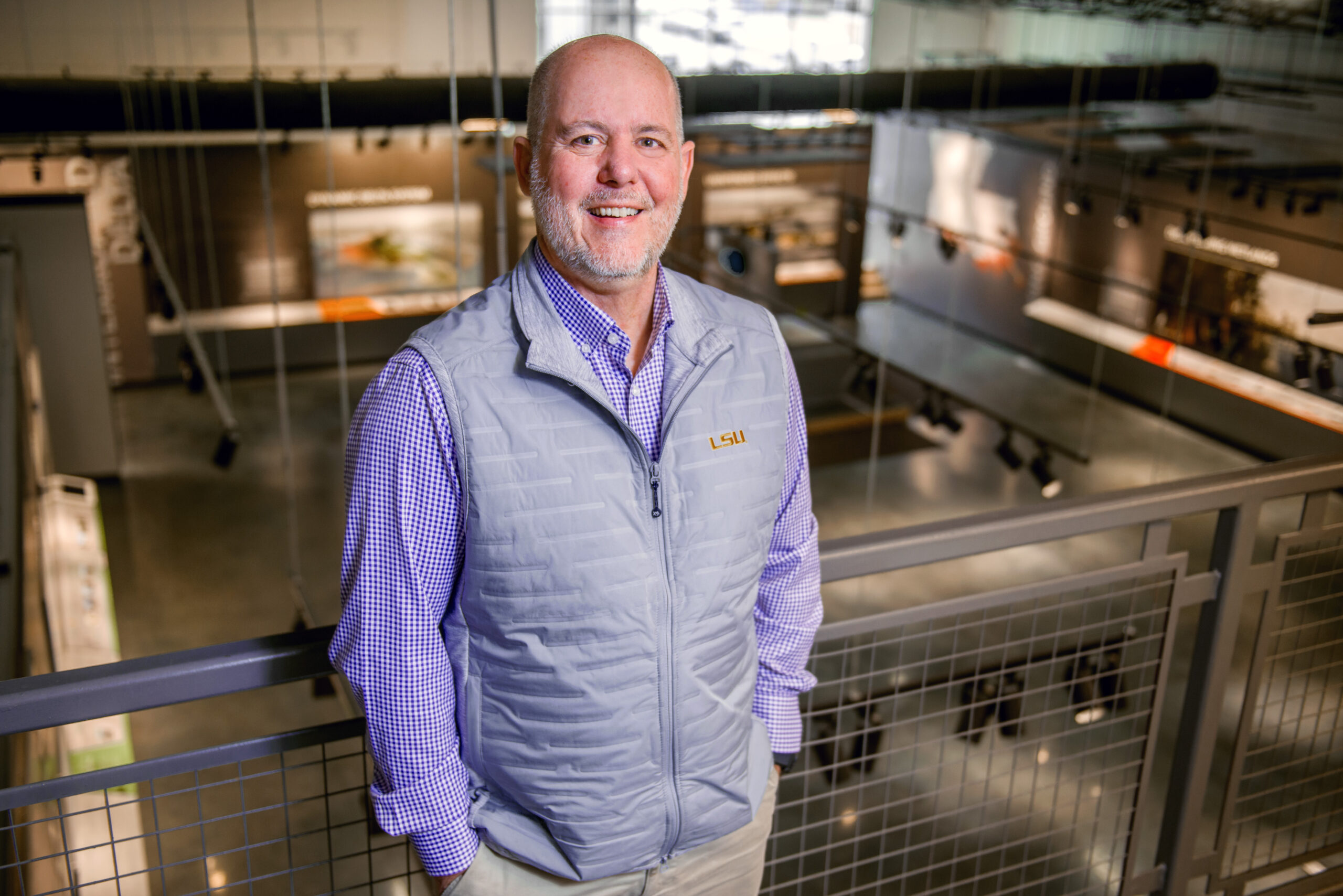
CLINT WILSON, director, LSU Center for River Studies (Don Kadair)
“We saw the move to the Water Campus as medium risk,” recalls Wilson. “We may be the only building out there in the Water Campus for a while, but eventually there will be more tenants—and that turns into a high-reward opportunity for LSU and students if it happens.”
Today, the Center for River Studies is home to the Lower Mississippi River Physical Model, a 90-by-120-foot movable bed physical model considered to be one of the largest of its kind in the world. The model shows how sediment is transported in the lower Mississippi River and its surrounding delta, and serves as a complementary planning tool to computer models and field data collection efforts.
The model, which recently celebrated its fifth anniversary, draws roughly 500 people during the Free First Sunday event each month, where visitors can enjoy downtown’s museums for free.
Next door is the Coastal Restoration and Protective Authority, or CRPA, and across the street along the riverbank sits the Center for Coastal and Deltaic Solutions, which houses The Water Institute of the Gulf, or TWIG, a not-for-profit applied research and technical services institution founded after Hurricane Katrina.
Beaux Jones, who took the helm at TWIG last summer following the untimely death of longtime leader Justin Ehrenwerth, calls the Water Campus a physical manifestation of the ideal that Louisiana can seize economic opportunities based on its expertise in handling coastal restoration and protection and other water management issues.
“If we make a collider of all those expertises, we can have both a measurable impact on other people’s ability to be resilient, but also create economic, cultural and intellectual opportunities for the state of Louisiana,” Jones says.
TWIG has seen considerable growth since relocating from One American Place in downtown Baton Rouge to the Water Campus. While the institute’s only client for the first five years was the state of Louisiana, TWIG has since worked with the state governments of Virginia, Florida and South Carolina as well as with nations Argentina and the Philippines.
Next door, 1200 Brickyard Lane also houses a handful of tenants whose reach extends far beyond the Capital Region. It is the first multitenant office building on the campus, and it has taken some time to fill the 94,000-square-foot building that was constructed in 2019, as its rental rates remain among the highest in Baton Rouge.
Last spring, the Water Campus was 79% occupied and was leasing for $32 per square foot—the same rate as in 2020. The average rate for Class A office space downtown was $26.06 last year, according to the Greater Baton Rouge Association of Realtors.
Global engineering and design firm Stantec was the first to announce its move into 1200 Brickyard Lane, in 2019, and was later joined by general contractor The Lemoine Company, which moved its Baton Rouge offices from Airline Highway to the campus in 2020. Lemoine’s move is also notable because the company served as the contractor for earlier work at the Water Campus.
The state’s budding cybersecurity sector has also planted its roots on the campus. LSU’s Stephenson Technologies Corporation partnered with the Louisiana National Guard in 2019 to develop the state’s first Joint Cyber Range and Training Center, which opened in 1200 Brickyard Lane in 2022. Environmental solutions firm Aptim also opened its new headquarters in the building in late 2022.
Altogether, some 13 commercial tenants—as well as 20 residential apartments—are located on the campus, though there’s room for more growth. As to the future of the Water Campus, the developers say additional phases are expected but there has been no decision on a timeline or what the phases would look like. Plans could also hinge on future development along the Nicholson corridor.
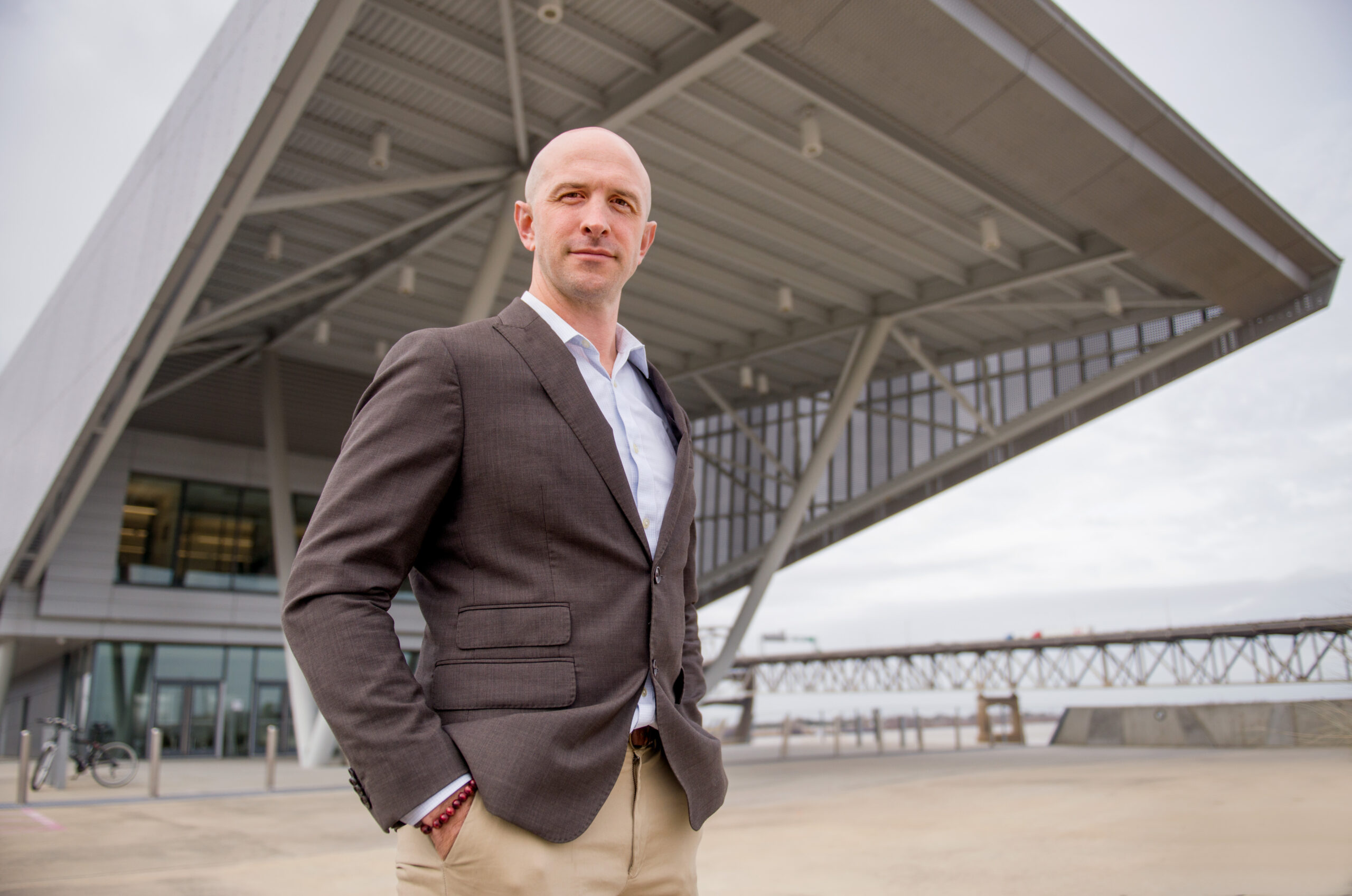
BEAUX JONES, president and CEO, The Water Institute of the Gulf (Don Kadair)
Last year, Commercial Properties bought some 30 acres off of Nicholson roughly a mile south of the Water Campus, and the development team says it is watching both the future development of that property and the Nicholson corridor as a whole.
“Future phases will incorporate some science and research of some kind,” says Carolyn Martin, CEO of Commercial Properties Realty Trust. “I think there will be a hotel in the next phase. Some of it depends on where the world ends up with people working in an office or not.
“If we can help the state recruit some businesses, I can see the Water Campus as being a type of incubator as well.”
