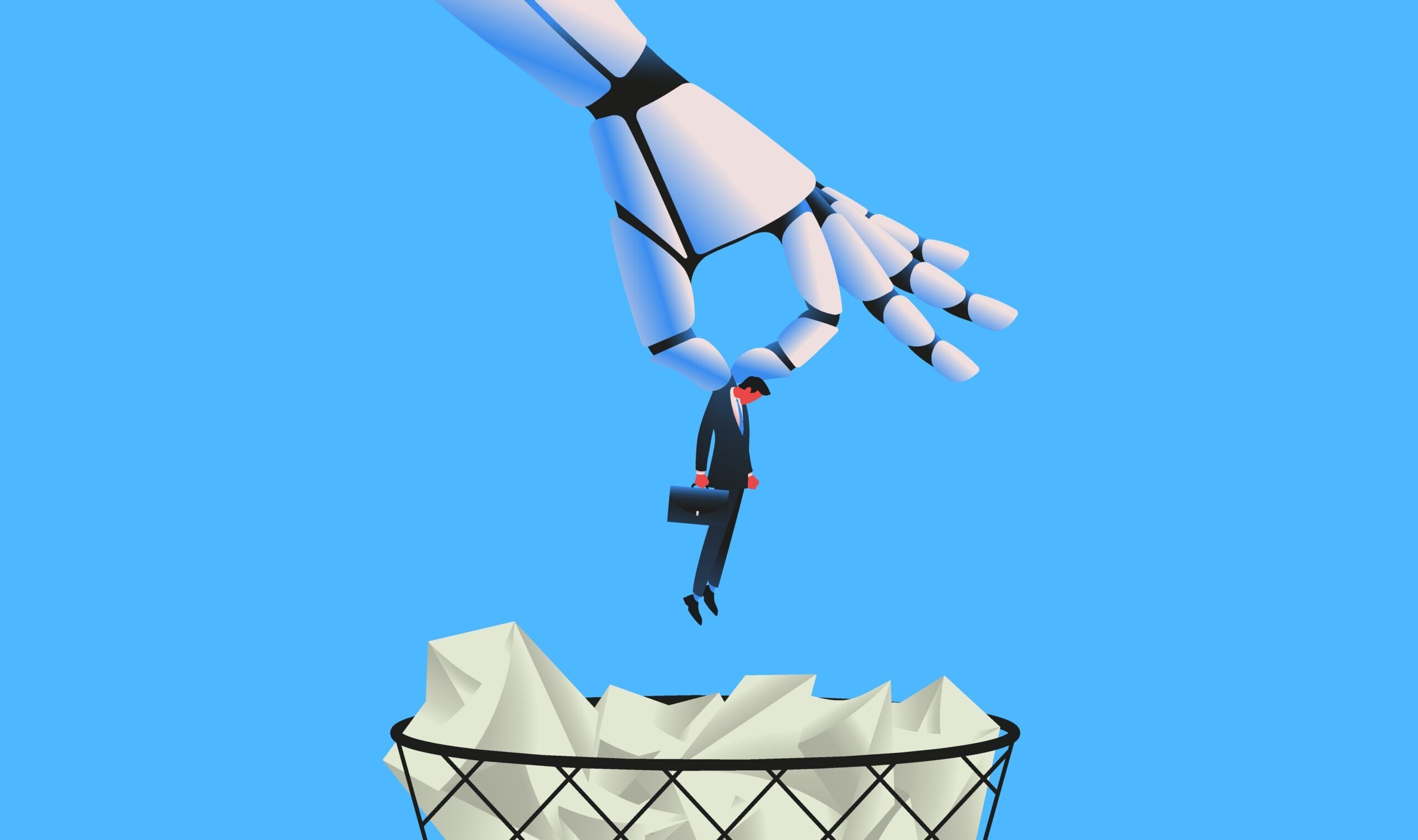
For much of the general public, it wasn’t long ago that artificial intelligence was considered a vague and distant threat, something reserved for sci-fi novels, tech conferences and TED Talks. That, of course, is no longer the case.
AI is here, and it’s almost certainly already in your workplace, doing tasks humans used to do. And with its rapid adoption has come a growing uneasiness among professionals who spend their days “looking at a computer,” as Andrew Yang recently put it in his widely circulated essay forecasting “the great disemboweling of white-collar jobs.”

Adrian Owen Jones, a partner at Baton Rouge’s Success Labs, sees that anxiety up close.
Through her firm’s executive coaching and consulting work, she’s fielding more questions than ever from business leaders wondering what AI will mean for their organizations and for their own careers.
“We’re seeing it across industries,” Owen Jones says. “More and more people are saying, ‘I need help figuring out how to navigate this.’ People are looking for answers.”
So what answers is she giving them?
Don’t panic, but don’t pretend it’s not real.
Owen Jones doesn’t sugarcoat the severity of the coming disruption.
“I think the gist of his statement is true,” she says of Yang’s prediction that up to 50% of the roughly 70 million white-collar jobs in the U.S. will be eliminated in the next several years.
She believes coastal markets will likely feel the brunt first, with effects gradually moving inland. Louisiana, she notes, may be somewhat insulated for a time because the industries that prop up its economy, like manufacturing, are highly dependent on physical labor. But ancillary white-collar functions in the same industries—HR, accounting, procurement, legal—are all vulnerable.
“I think we’re starting to get the mist,” she says. “I think our feet are going to start getting wet in the next two years, and I think we’re going to be waist-deep fighting the current in the next five. I think a lot of people are going to be completely underwater in the next 10.”
Acknowledging that reality, she says, is the first step toward navigating it.
Don’t leap out of fear.
Though it may seem counterintuitive on its face, one of Owen Jones’ biggest pieces of advice for professionals worried about their job security in the age of AI is simply to stay put.
In a stable labor market, exploring new opportunities can be a smart play. In a volatile one, it’s riskier. Rather than jumping ship to an unfamiliar organization where you lack political capital, it may be a better idea to batten down the hatches.
“If you’ve got a good-paying job and you’ve got valuable institutional knowledge and you’ve built relationships and trust in your organization, you are not going to find greener grass,” she says.
Prioritize relationships.
Technical skill alone won’t determine who stays and who goes. In every downsizing discussion, there are advocates who fight to keep certain employees and detractors who fight to cut certain employees.
That’s why Owen Jones advises drafting what she calls a “stakeholder map”—an honest assessment of who holds the most influence over your career trajectory and how strong your relationships with those individuals are.
“Take the time to really map out the relationships that are going to potentially influence your career, and then nurture those relationships like hell,” she says.
Relationships, reputation and trust may ultimately prove more valuable than any single technical competency.
Become adaptable.
As important as strategy is mindset. Those who weather the storm will be those who are pliable and enthusiastic about finding ways to thrive in times of change.
Those who see change as something happening to them are more likely to struggle. Cultivate an “internal locus of control”—the belief that one’s own actions and decisions are what determine life’s outcomes—and you’re more likely to endure.
It’s probably wise to embrace AI tools rather than resist them. Others will take notice if you’re actively furthering the conversation about how technology can strengthen your organization.
Be what AI isn’t.
Owen Jones sees hope for those who bring a distinctly human edge. Those who make themselves indispensable in ways large language models can’t replicate—say, because of their strong relationships, their shrewd judgment or their “ability to hold a room through hard conversations and harder decisions”—will ultimately prove difficult for the robots to replace.
GET DAILY REPORT FREE