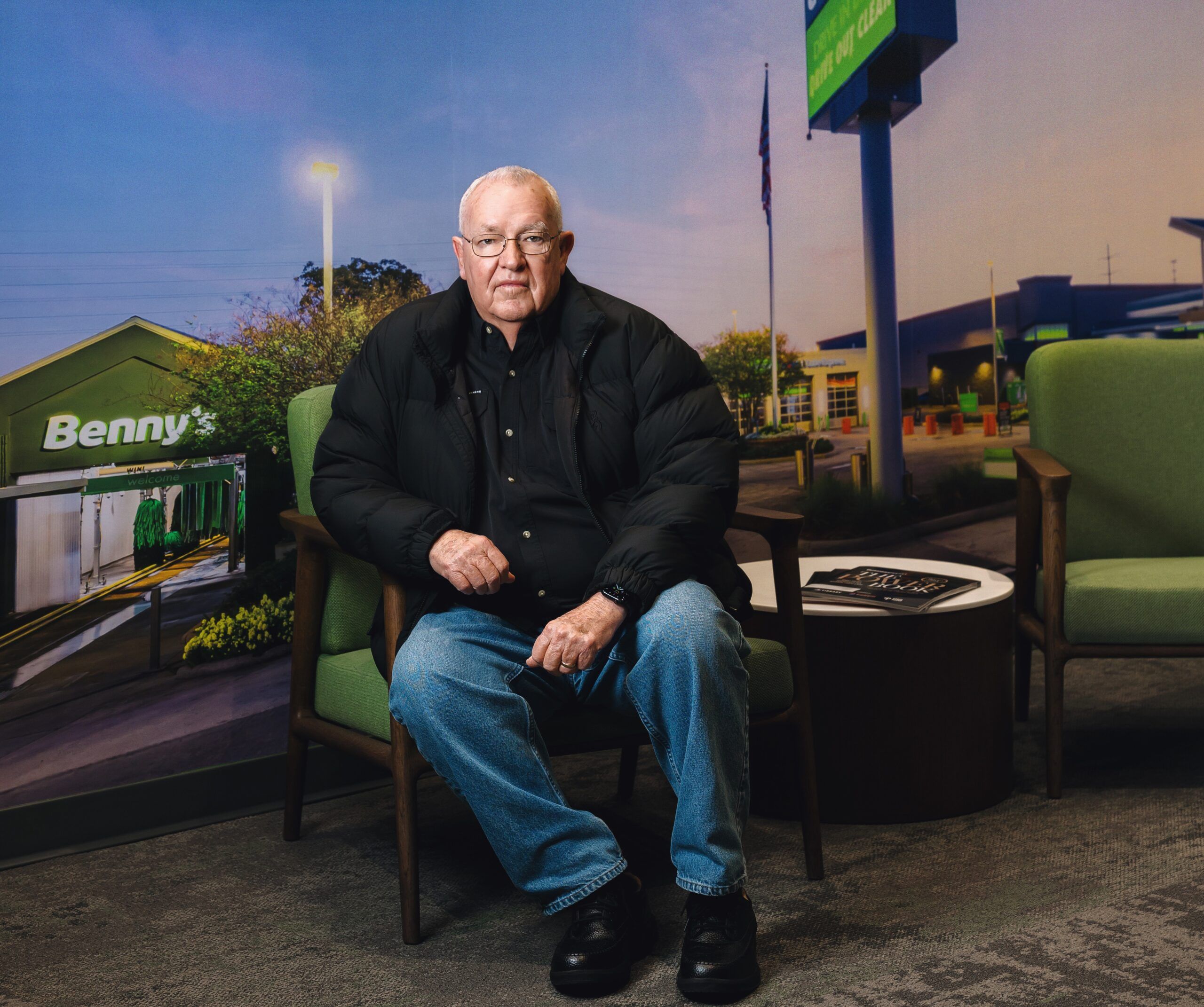
At 80, Benny Alford still comes to work every day at the new corporate headquarters of Benny’s Car Wash. His office window overlooks the Airline Highway operations, and his door remains open, literally.
“I never close my door. It’s always wide open for everyone,” he says. Family members, staff and even strangers seek business advice. With 440 employees, that open door sees constant traffic.
“He never tells anybody ‘no,’” says son Justin Alford, who runs Benny’s with his brother Jason Alford and Jason’s daughter, Helen Alford McDavid. “He’s our patriarch. And we call on him for everything.”

It’s a fitting culmination to a career that began when Benny Alford was a third grader, working weekend shifts as a cashier at his father’s car wash. The math was simple back then. “It was all the same price; it wasn’t but a dollar,” he recalls. For larger bills, he’d check with his father to ensure the change was correct. His sisters worked there, too, “but I was the baby,” he says. “Everybody in my family worked. I didn’t know any different.”
From those humble beginnings, Benny Alford would grow up to revolutionize an industry.

The family car wash story began across state lines. Benny’s father, Lloyd Alford, started a locksmith business in the 1940s in Panama City, Florida, then recognized a lucrative opportunity and shifted gears, opening a car wash in Pensacola, Florida, in 1951, when the industry was in its infancy.
Family ties brought Lloyd to Baton Rouge, where he noticed that gravel and dirt roads meant cars were often dusty, muddy or a gunky blend of the two. He opened Florida Street Car Wash in 1953 to serve that obvious need, planting the seeds of what would become a local business empire.
Benny attended Nicholls State University in Thibodaux, and the University of Southwestern Louisiana in Lafayette (now UL Lafayette), before leaving college to work full time at the car wash; he took over leadership from his father in the late 1960s. “This is the only thing I wanted to do,” he says.
The innovation that changed everything
In the decades Benny has spent in the car wash business, he’s seen it all: the stuffed rattlesnake that looked so lifelike it made attendants jump backward when they opened a car door to vacuum its interior, hunters rolling in with dead deer on ice in the back seat, and the parade of automotive history itself: Cadillacs with “3-mile-long” fins; classic ‘57 Chevys; Chryslers with oversize whitewalls that were a challenge to keep white; luxe Rolls Royces and Bentleys; those improbably tiny Fiats.
But these weren’t idle observations. Changing car styles demanded constant adaptation—equipment modifications to accommodate everything from classic hood ornaments that could rust and snap off to radio antennas that extended and retracted, and once-trendy vinyl tops that scratched when subjected to abrasive solvents or stiff-bristled brushes.

Environmental factors added another layer of complexity: fluctuating temperatures affecting which cleaning solutions to use, salt-covered cars during icy weather, the sticky persistence of smashed love bugs on the windshield each spring and fall.
It was a labor-intensive business, but by the 1990s, it became tough to find enough employees to run a full-service operation. Benny, who served on the board of the International Car Wash Association, visited a friend’s operation in Germany to check out a model that invited customers to vacuum their own interiors, which represented a first step toward self-service.
After much research, Benny and his sons created the modern-day express car washing system. Drivers select cleaning options at an automated pay station; a gate system keeps the cars in the correct order. Drivers stay ensconced in their cars while gliding through a tunnel where brushes and blowers take over. After emerging, customers handle their own vacuuming.
The innovation cut labor needs dramatically and attracted the attention of operators from across the U.S. and from every continent but Antarctica who came to study the system as a model of efficiency. “There were 30, 40 people here at a time, 100 people a month,” Benny says, of the international visitors.
“People did say it’s not going to work,” Justin Alford says, “but we opened in 2001 and we knew almost instantly. It took off pretty quick. Now it’s the biggest trend in the car wash industry.”
Benny was generous with sharing trade secrets. “I’m not into that, getting a patent, going through the hassle. I’ll share it with everyone.”
The business expanded into oil changes, inspection stations, convenience stores and fuel—all while maintaining a deep commitment to the Baton Rouge community.
Benny preferred to keep the business local. The family, as a group, makes a weekly 80-mile trek to visit all the locations to forge and foster personal connections. If he’d expanded beyond the region, he says, he wouldn’t have gotten to know his employees. “Management-wise, it would be very hard. I never wanted to be the biggest car wash. I want to be the best-run car wash, the best managed, to have the best people.”
Benny succeeded, he says, by adopting his father’s leadership style. “My dad was pretty much the same as I am,” Benny says. “Level-headed, believed in his people, too. We treat customers and employees the way we would like to be treated. You can build these car washes anywhere, everywhere, but you have to run them, and they run a lot smoother if you’ve got good employees.”
Team members are offered CPR classes, wealth management courses and other life skills training along with tuition assistance. “People want to learn. They don’t want to be bored at work,” Justin says.
The company provides flu shots, health fairs with mini physicals, crawfish boils for families, and Christmas parties. Members of younger generations who grew up “lonely” playing on computers often need strong mentorship to succeed in a people-oriented business, Justin says. Managers have the budget to create a community by treating their employees to pizza or taking them out bowling. And they succeed. Employees look out for one another; they form friendships. “We have a lot of married couples washing cars,” he adds.
Benny is proud, too, of those who got their start at a car wash or convenience store and later found success elsewhere. “We have dentists, doctors, architects, engineers—golly. Sometimes I’ll run into somebody who worked with us, studied with us. They have life-changing stories about working here.”
Others have stayed on for 30-plus years. “It says something about how my dad handles people that they like staying here,” Justin notes.

Reflecting on 75 years in business
Benny was 21 when he married his wife, Pat, on a rainy February day in 1967. The couple honeymooned over a weekend in Biloxi, Mississippi, where his bride was afraid of stepping foot in the Gulf, worried about the sensation of fish flitting around her ankles.
He shakes his head in disbelief at the passage of time. “She stuck it out, and it’s not been easy,” he says. “The person you marry, your spouse, will never understand the amount of time you have to spend away from your family.” He talks about how many dinners she had to reheat because he was late getting home.
“You’re never off. Ever,” Jason Alford adds. “We are 24 hours a day. It’s a 24-hour business.”
This year, Benny’s celebrates 75 years, operating nine car wash locations, seven oil changes, and five B-Quik convenience stores with more to come this year.
“I like the people, our customers and our employees,” Benny says. “Knowing your employees and talking to them, making them feel like family. I’m proud of them. I’m most proud of my kids and my granddaughter, of how they’ve come in and taken it to another level.”
Milestones
Oct. 30, 1945
Benny Alford is born in Panama City, Florida.
1951

Benny’s father, Lloyd Alford, opens the family’s first car wash, Pensacola Autowash, in Pensacola, Florida.
1953

The business expands to Louisiana and the Florida Street Car Wash opens in Baton Rouge.
1957
Lloyd opens a second Baton Rouge location on Plank Road, which later gains fame as a filming location for the 1982 movie The Toy, starring Jackie Gleason and Richard Pryor.
Feb. 17, 1967

Benny marries Pat Leblanc.
Late 1960s
Benny takes over the family business from his father, kicking off the second generation of leadership.
1989
Joins the Krewe of Endymion in New Orleans with his sons and remains a member to this day. In 2022, granddaughter Helen serves as Endymion’s queen.
1992
Rebrands Florida Street Car Wash as Benny’s Car Wash and launches its first location under the new name—on Airline Highway.
1993

Introduces Benny’s Oil Change.
1998
Opens the first B-Quik convenience store with sons Justin and Jason, expanding the family business beyond car washes to convenience stores, fuel and oil changes.
2001
Makes history by opening the first modern express car wash at the Perkins Road location.
2016

Modernizes the brand look and changes signature color from maroon to green for more impact. Introduces a membership program.
2025
The company opens new corporate office building on Airline.
2026
The company celebrates 75 years in business, with now nine car wash locations, seven oil changes and five B-Quik convenience stores. Two more car washes are scheduled to open in Baker and Zachary. The company continues under the ownership of Benny and sons Justin and Jason Alford, along with Jason’s daughter, Helen Alford McDavid.
Read about the other 2026 Business Awards & Hall of Fame honorees.
GET DAILY REPORT FREE