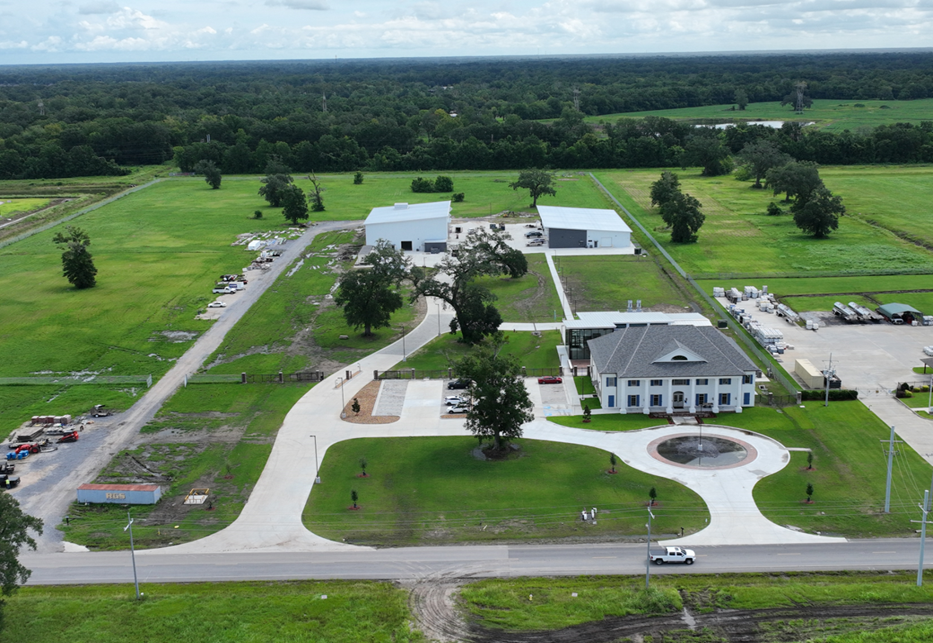

A chemical manufacturing facility near Dutchtown is positioning itself for long-term growth as it navigates federal approvals and works toward commercial production.
Skyfall Biologicals has operated in Ascension Parish for about four years, developing products aimed at agriculture and consumer health — including a potato sprout inhibitor and a mosquito repellent — while remaining in the early stages of commercialization.
Company leaders cite support from Louisiana Economic Development and the Ascension Economic Development Corp., along with the region’s established petrochemical workforce and infrastructure, as key factors in the decision to locate here.

“I know anecdotally that the owner of our holding company in Idaho had done a search throughout the U.S. and specifically the Gulf Coast area, and he was very enamored with the Louisiana Economic Development here, the secretary at the time, and got introduced to Kate McArthur, the Ascension Economic Development Corporation CEO,” says site manager Charles Freeburgh. “Our owner, John Forsythe, tells me that was a done deal once he talked to them.”
Skyfall’s business model centers on producing specialized chemicals for a limited number of customers. Its potato sprout inhibitor — used to extend storage life — is tied to its Idaho-based parent company, 1,4 Group, while its mosquito repellent is manufactured for Florida-based Entomol.
Domestic production was a deliberate choice. “We’re making this product internally in the U.S., because this product is currently only manufactured in mainland China, and our owner specifically felt the pain during the business disruption from COVID and the supply chain disruption back in 2020-2021 as it was trying to recover,” Freeburgh says. “That’s when he made the commitment that we’re going to build our own facility to make our product in the U.S.”
For now, the company is focused on demonstrating its production processes and securing U.S. Environmental Protection Agency approvals — a multiyear effort that will determine when its products can reach the market. Freeburgh describes the company as being in a “holding pattern” while it awaits those approvals.
Skyfall currently employs about 14 people, including full-time staff and contractors. If approvals are secured, the company plans to construct a commercial-scale plant by 2028 or 2029 and could grow its workforce to as many as 30 employees.
The timeline was always long by design. “We have yet to get our products approved so that we can get them to market by design,” Freeburgh says. “We knew that John Forsythe considered this essentially a 10-year project before we’re fully commercialized. We’re four years in. We’re not even halfway in our journey to where we will have production of approved products to be able to go to market.”
The company’s 30-acre site, purchased about five years ago, was designed with expansion in mind — with room for additional manufacturing and potential co-located “boutique” chemical producers.
In the meantime, Skyfall has worked to establish roots in the community, partnering with River Parishes Community College, hosting student tours and supporting local outreach efforts.
“Skyfall Biologicals looks at what nature provides already and fix that to better processes, to better others lives, to better food supply and others health,” says supply chain manager Alexis Goodman.