
Straight Talk with Ascension Parish Public School Superintendent Edith Walker

As workforce development and rapid economic growth reshape Ascension Parish, local schools are under increasing pressure to prepare students for both college and careers. In this Q&A, Ascension Parish Public Schools Superintendent Edith Walker describes how the district is aligning classroom instruction with industry needs, measuring student success beyond graduation, and navigating challenges ranging from teacher retention to rising costs—all while strengthening ties with the business community to build a more job-ready talent pipeline. This interview has been edited for brevity and clarity.

With workforce development becoming a major priority across Louisiana, how are Ascension Public Schools aligning curriculum and career pathways with the needs of local industry?

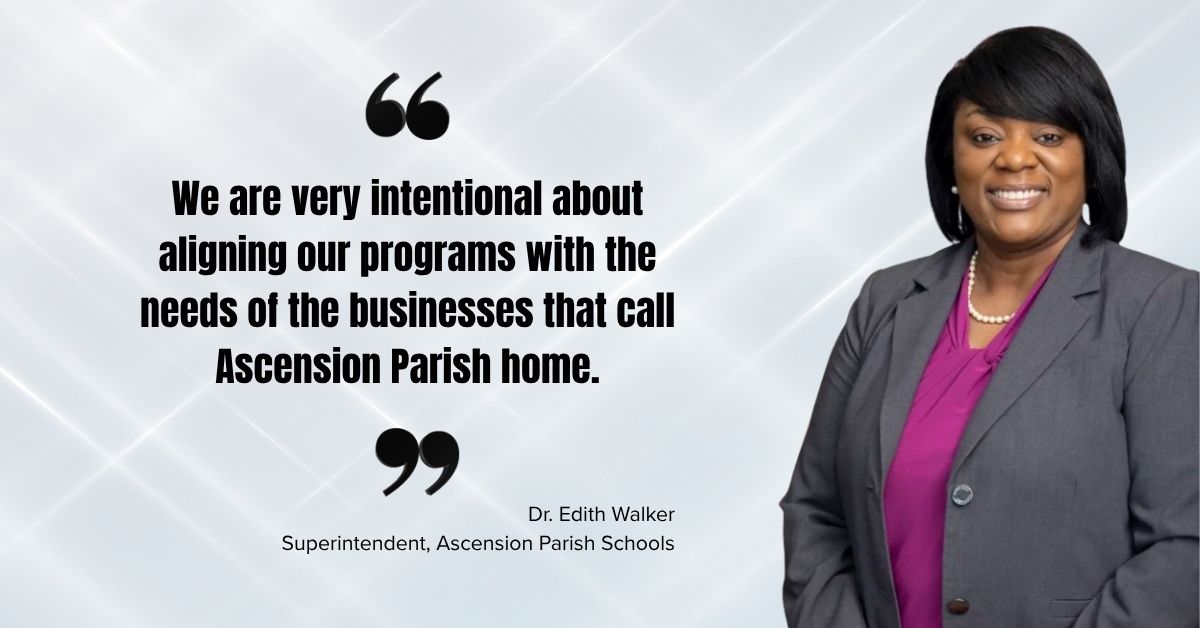
We are very intentional about aligning our programs with the needs of the businesses that call Ascension Parish home. As our community continues to grow, we actively seek out career and technical pathways that connect directly to local industry. Our goal is for students to graduate not only with a diploma, but with industry-based credentials that position them to enter the workforce immediately. As new industries emerge, such as carbon capture and companies like Hyundai Steel, we work to understand the skills and talent they will require. We maintain close relationships with business leaders, executives, and HR teams to ensure we are preparing students for real opportunities that exist right here in our community. My role on the Ascension Chamber of Commerce board provides valuable insight into the challenges and workforce demands facing local industry. I bring that perspective back to our schools, collaborating with our career and technical educators and school counselors to ensure our students are equipped, certified and ready to meet those needs.

What metrics do you rely on most to evaluate whether students are truly prepared for life after graduation—whether that’s college, careers or entrepreneurship?

I measure our success in a few key ways. First, I look at the opportunities our students earn, particularly scholarships. Last year alone, the Class of 2025 earned $27 million in scholarships, opening doors to a wide range of postsecondary pathways. That success is reinforced by access to over 70 college-credit courses in our high schools and the 1,800 industry-based credentials our students have earned. Second, I look at how many of our students take the next step: enrolling in postsecondary education or training. Enrollment is a strong indicator that students are not only prepared, but motivated to pursue their goals. Finally, I consider how many of those individuals return to Ascension Parish building careers, raising families and choosing to educate the next generation here. Across all three measures, I believe we are delivering a high-quality K-12 education

- Advertisement -

Teacher recruitment and retention remain challenges statewide. What specific strategies are proving most effective in Ascension Parish, and where do gaps still exist?

Our greatest strength in recruiting and retaining teachers in Ascension Parish is the level of support we provide in the classroom. When educators come here, they are equipped with the tools, guidance and resources they need to feel successful and that sense of success is what encourages them to stay. A second key strategy is our in-house alternative certification pathway, Teach Ascension Academy. This program allows individuals with a college degree to transition into teaching, even if education was not their original field. We provide targeted training in instruction, classroom management, and student support to ensure they are fully prepared to succeed. We also recognize the importance of competitive compensation. We are continuously working to improve salaries and benefits, including providing incremental raises and helping offset rising insurance costs. These efforts play a critical role in attracting and retaining high-quality educators. Ultimately, though, retention comes down to whether teachers feel successful and supported in their work. Like many districts, we continue to focus on strengthening our support systems, particularly in special education, so that both our teachers and students receive what they need to thrive.

What role should technology—particularly AI and digital learning tools—play in the classroom over the next five years, and how is the district preparing for that shift?

Ascension Public Schools has a strong track record of innovation, particularly in technology. With the support of our community, we established and continue to renew a dedicated technology millage that provides a computing device for every student from pre-K through 12th grade, which is an investment we made well before COVID. We have also been leaders in classroom technology, becoming the first district in the nation to implement Promethean ActivWall technology in 2015. Today, every classroom across our district is equipped with an interactive learning tool. This year, we introduced MagicSchool AI for our teachers and are actively developing thoughtful policies and procedures to ensure the safe and effective use of AI with students. While we are proud of our history of innovation, we recognize that emerging technologies, especially artificial intelligence, are rapidly reshaping how business and industry operate.

What are the biggest financial pressures facing the district today, and how might they impact programming or capital projects in the future?

One of our biggest financial challenges is the rising cost of materials, fuel, and insurance. These expenses continue to increase at a rate that often outpaces funding growth. As a result, we are intentional about making strategic, responsible decisions to ensure we can manage these pressures without compromising our capital projects. It’s important to us that we deliver on the commitments we have made to our community while remaining fiscally responsible. Another key factor that is not always widely understood is how state funding works. This is not a complaint, but rather important context for understanding school system finances. As local revenues, such as sales tax and ad valorem taxes, increase, state funding through the Minimum Foundation Program (MFP) is adjusted downward. In essence, there is an offset within the state formula that limits our ability to fully benefit from local revenue growth. While we remain committed to being strong stewards of our resources, these structural and economic factors do present ongoing challenges that require careful planning and thoughtful decision-making.

How do you view the relationship between education and the business community?

Education and the business community go hand in hand. Our ultimate responsibility is to prepare students for life beyond the K-12 setting, and that future almost always includes the workforce. We rely on one another. Our students need opportunities, and businesses need a skilled, prepared workforce. That shared goal makes collaboration critical to our success. We’re proud of the strong partnership we’ve built. Our business community provides honest, constructive feedback on the strengths and areas of growth within our school system, helping us continuously improve. In turn, we work closely with them to connect students to employment, training, and real-world learning opportunities, as well as to support professional growth for our educators. 

- Advertisement -

Anything else you’d like to add?

We need our Ascension business community to know just how essential they are to the success of our students. Their role goes far beyond future employment opportunities. We need them as mentors, partners, and real-world guides. Our students need access to meaningful experiences: internships, apprenticeships, job shadowing and opportunities to learn and grow in authentic environments. This work isn’t just about dollars and cents. It’s about impact. The insight, guidance and opportunities our business community provides are invaluable, helping us prepare students not just for jobs, but also for life.