

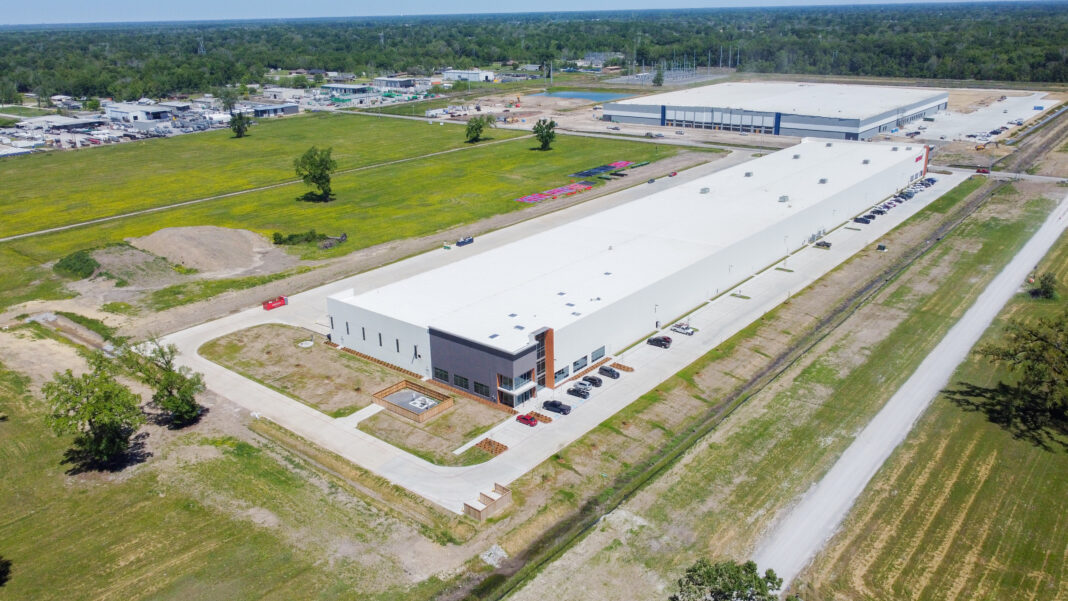
Baton Rouge’s industrial real estate market continues to operate under tight supply conditions, even as vacancy rates have ticked higher—setting it apart from broader national trends where slowing demand and rising availability are reshaping the sector.
That’s according to Evan Scroggs with Lee & Associates, who spoke at the annual Trends seminar sponsored by the Greater Baton Rouge Association of Realtors on Thursday.
At the end of 2025, Baton Rouge’s industrial vacancy rate stood at 4.38%, up from 2.91% a year earlier but still well below the national average of roughly 7.6%. Total inventory reached about 38.7 million square feet, with net absorption remaining positive despite a slowdown in leasing activity.
The increase in local vacancy is largely tied to a handful of large, specialized properties rather than a broad softening in demand. Two buildings alone account for nearly half of the market’s vacant space, skewing overall figures. The former Conn’s, 250,000 square feet, in Port Allen and the Stupp Corporation six-building rail complex, 564,400 square feet, combine for 814,400 square feet. The former Conn’s building has been vacant since Q4 of 2024, while the Stupp complex facility was fully vacated in the first quarter of 2025.
“These two facilities alone account for 48% of the whole vacancy in the marketplace,” Scroggs said.
Excluding those assets, vacancy would sit closer to 3%. Scroggs said there is effectively no vacancy in newly constructed or first-generation industrial space—a trend that has persisted for years. That dynamic continues to push tenants into older, functionally obsolete buildings or forces them to delay expansion plans due to limited options.
The imbalance reflects a longer-term pattern. Since 2013, annual absorption in Baton Rouge has consistently outpaced new construction deliveries, leaving the market in a structural deficit. As a result, growth is being limited not by demand but by the availability of modern facilities.
That supply constraint is becoming more pronounced as development faces rising land costs, elevated construction expenses and tighter financing conditions—particularly in high-growth areas like Ascension Parish, which led the region in industrial permitting activity in 2025.
“Tenants are taking longer to make decisions,” Scroggs said. “Naturally, what you’re seeing is that tenants are much slower in the decision-making process.”
Meanwhile, several large-scale projects are expected to test the depth of tenant demand in the near term. More than 700,000 square feet of industrial space could be absorbed in 2026 if pending leases materialize across key developments, including new speculative and build-to-suit facilities.
Some notable projects include the 120,000-square-foot build-to-suit facility for U.S. AutoForce on Rieger Road, which is in progress, the completion of the 61 North Logistics Center on Tom Drive, Ferguson’s 64,924-square-foot facility on Old Perkins Road and the 254,000-square-foot Rivermark 185 Building II, which is expected to be completed in May.
Nationally, the industrial market is undergoing a different kind of shift. Demand has declined for three consecutive years, with tenant requirements down about 10.9% year over year, according to industry data. Vacancy climbed from historic lows near 3% in 2022 to roughly 7.6% by late 2025.
Scroggs expects both local and national markets to stabilize, but the paths will differ. Nationally, vacancy is projected to peak around 2026 as supply and demand rebalance. In Baton Rouge, vacancy is expected to remain relatively tight. He also mentioned that Baton Rouge could benefit from data center developments.
“Baton Rouge is uniquely positioned to benefit from all of this data center development, not from data centers themselves, but from the contractors and subcontractors that are servicing the data centers,” he said.
