
Two of the region’s leading cancer organizations—Mary Bird Perkins Cancer Center and Ochsner Cancer Center—are pushing deeper into underserved communities, deploying new technology and rethinking how care is delivered. The challenges of access, staffing and financing remain formidable, but the distance between patients and quality care is shrinking.
Nearly 80% of Louisiana’s land is classified as rural, and for many residents in those communities, a cancer diagnosis has historically carried an added burden: The nearest high-quality treatment center is hours away. The Capital Region, shaped by pockets of poverty, high rates of modifiable risk factors and longstanding gaps in access to specialist care, sits at the center of this challenge.
Dr. Burke J. Brooks, medical oncologist at Ochsner Cancer Center in Baton Rouge, has been practicing in the region for nearly four decades. He is direct about the underlying dynamics.
“We live in an area that is a relatively poor area of the United States,” he says. “And poverty is known to be a major risk factor in developing cancer, mainly because people who have lower economic levels tend to smoke more. And smoking is a major risk factor for cancer. The second most important risk factor for cancer is obesity. So between tobacco use and obesity, that accounts for nearly 50% of all cancer in the United States. And so, we see the effects of that here in the south Louisiana area.”

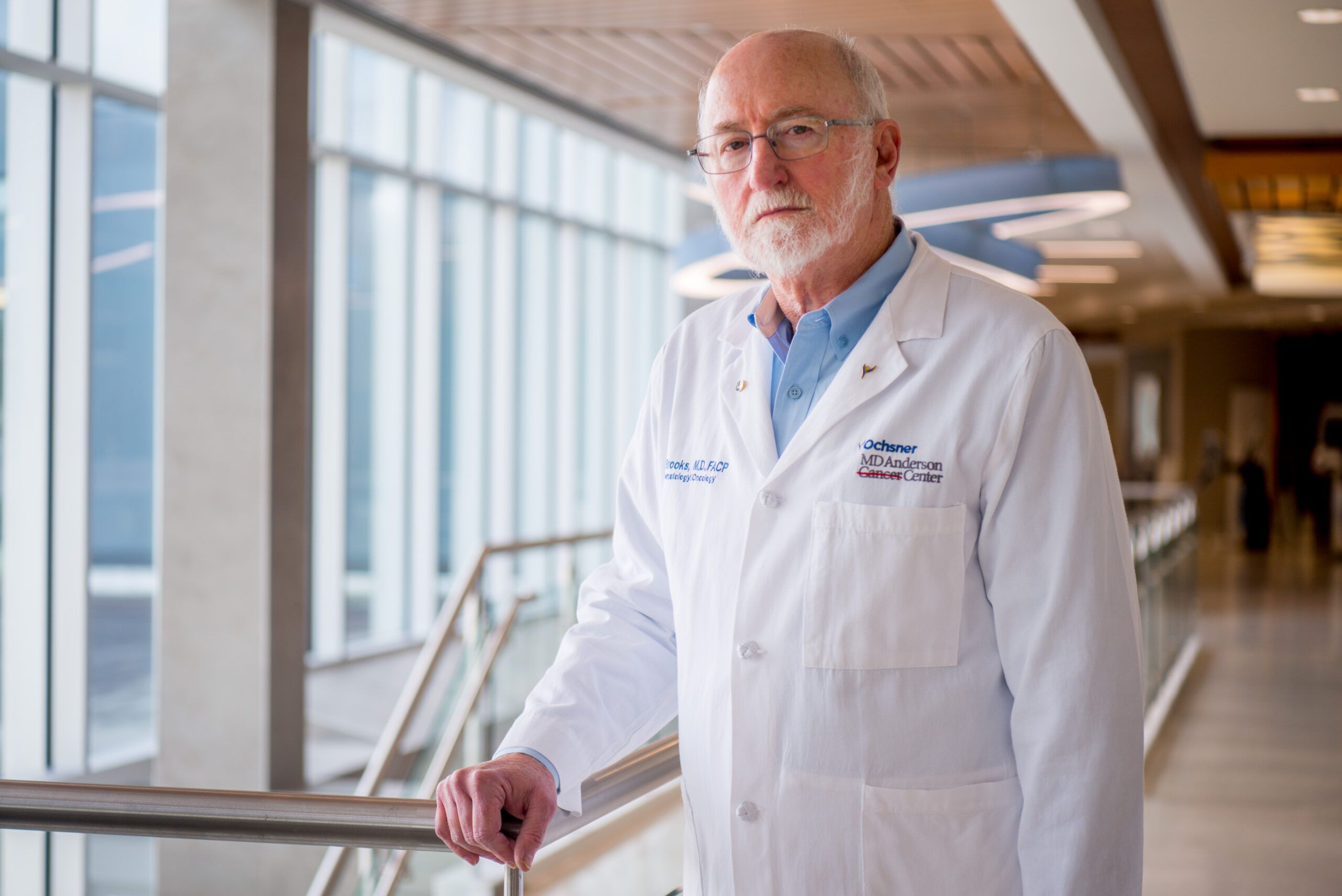
Brooks is also skeptical of the environmental narrative that has come to define the region’s cancer identity. “A lot of people have talked about `Cancer Alley’ between New Orleans and Baton Rouge. That, in my opinion, has been a pretty well-worn statement and I’m not sure it’s a deserved one. I believe that protecting the environment is absolutely critical, but to directly relate that to someone’s individual cancer is a very large leap. I don’t see clusters of cancers around groups of people directly related to chemical exposure.”
The cancers he sees are more often common than rare, and, as he sees it, often driven by tobacco, diet and unmanaged chronic disease. “The most polluted air in the world is the breath of a smoker,” he says. “I’m not saying pollution shouldn’t be investigated—but we shouldn’t let it become a scapegoat that distracts from modifiable risk factors.”
Two Models, One Mission
Mary Bird Perkins Cancer Center and Ochsner Cancer Center approach the access problem from different vantage points, but both are accelerating efforts to bring care closer to patients who have historically delayed or gone without it.
Mary Bird Perkins, headquartered in Baton Rouge, has grown from a $35 million health care organization to one generating roughly $350 million to $400 million in annual revenue, says President and CEO Jonas Fontenot. Today the center serves patients across more than 23 locations in Louisiana and southwest Mississippi.
That growth has enabled a deliberate expansion into communities where cancer care has not traditionally been available.
Beginning in 2022, the center began strategically expanding its regional partnerships to broaden access. In early 2023, it partnered with Opelousas General Health System to expand care to Opelousas. Its largest expansion came in early 2024, when it extended services into central and north Louisiana through a partnership with MD Clinics. And its newest location, in Leesville, is set to open in April.
Fontenot says each expansion is preceded by an assessment that there is a substantial need.
“Access is getting more difficult, not less difficult, in this state,” Fontenot says. “The center’s singular focus on cancer is a competitive advantage that benefits the community. If you’re a hospital or health system, you have 35 or so specialties in addition to the needs of inpatient care. There are always limitations on resources. We lack that internal competition among specialties, so we can devote all our time and resources to cancer care.”

Ochsner’s approach is aided by a major institutional partnership. In June 2023, Ochsner Cancer Center formalized a relationship with Houston-based MD Anderson Cancer Center. “It’s an incredible relationship that directly affects our patients on a day-to-day basis,” Brooks says.
The partnership operates across multiple dimensions. To coordinate care, MD Anderson adopted the Clinical Pathways tool Ochsner had been using—a system that integrates treatment recommendations for 85% of cancers directly into medical records. On top of that, a peer-to-peer consultation program gives Brooks and his colleagues direct access to leading MD Anderson specialists via the shared online Epic system. “When I have a question about a particular patient, I can direct that to one of the leading experts in the world,” Brooks says.
Treatment plans for radiation oncology patients at Ochsner are reviewed by MD Anderson specialists via Zoom before treatment begins. Surgical cases receive expert second opinions before the operating room.
“All of our radiology, our pathology, our operating rooms have met all of the standards that MD Anderson has looked at, which represents an incredible amount of effort on our part,” Brooks says. “It took us two years to reach that level of expertise. For certain patients who might otherwise want to travel to Houston, there’s often no need.”
Reaching Rural Communities
Both organizations face the same fundamental geography problem: Patients in rural areas are often the sickest, the least screened and the hardest to reach.
Mary Bird Perkins operates Prevention on the Go, a mobile screening program established in 2002 that delivers comprehensive prevention and early detection services across a 30-parish and county service area. The program provides screenings to communities and directly to workplaces. In 2025, the program reached 5,400 unique participants, connecting many first-time or underserved patients to care. Philanthropy funds the program, with the Louisiana Department of Health as a supporting partner.
Patients who present with early-stage disease require less complex, less expensive treatment and achieve better outcomes. Late-stage presentations drive up uncompensated care costs and require multiple therapies that strain patients financially and organizations operationally.


Ochsner has leaned into telehealth as a bridge to rural patients. “The use of telehealth, accelerated by the pandemic, has helped people stay closer to home,” Brooks says. “Most people today, if they have a cellphone, can access virtual visits.” The organization has also established partnerships with rural clinics. “It is a challenge, and we fully acknowledge that,” he says.
Staffing those rural outposts can also be a challenge. Mary Bird Perkins’ medical director of medical oncology and hematology, Dr. Daniel LaVie, says his recruitment strategy depends on identifying people with genuine ties to the region and filling specific voids. “Most people without a real connection to the area are hard to recruit,” he says.
The center’s commitment to removing logistical barriers goes beyond outlying clinics. In 2025 alone, Mary Bird Perkins distributed 2,300 gas cards and provided more than 3,000 rides to help patients get to appointments.
Early Detection: The Cultural and Technological Frontier
The biggest obstacle to early detection is cultural, rather than logistical.
“The number one obstacle is fear,” Brooks says. “People are fearful of a cancer diagnosis. We try to educate patients that cancer is common—one out of three of us in our lifetimes will be diagnosed with invasive cancer.” Early diagnosis is incredibly important to prevent dying from cancer, and to minimize the treatment required, he adds.
Fontenot echoes that: “People don’t always realize that screenings are free. And more fundamentally, many are conditioned not to act before they have symptoms. You have to make it as available as possible, and then if someone has an abnormal result, you connect them with who they need to see.”
On the technological side, a significant shift is approaching. Brooks describes a blood test that detects small fragments of DNA shed by certain cancers at early stages, a multi-cancer early detection tool that his team has been piloting in a research setting. It can detect many cancers that previously had no screening options.
“We’ve already detected an early cancer in half a dozen patients,” he says. “This is a new area that will be emerging in the next several years.” He expects the tests will be widely available quickly and though cost could initially be a barrier, competition should make it more affordable.
Beyond that, Ochsner’s precision medicine program screens for genetic predispositions to cancer— identifying family members at elevated risk and routing them to a high-risk clinic for tailored screening plans.
The HPV vaccine has dramatically reduced the incidence of cervical cancer, and Louisiana has performed well on vaccination rates. Hepatitis C screening has made major inroads in reducing liver cancer. And GLP-1 drugs, now widely used for weight loss, may become one of the most significant cancer prevention tools to emerge in years, Brooks believes. “Better weight control should have a dramatic effect on reducing the 20% of cancers related to obesity,” he says.
Mary Bird Perkins’ investment in research reflects the same forward orientation. In 2025, the center enrolled 102 new patients across 52 clinical trials, expanding access to innovative treatment options for patients who might not otherwise qualify for cutting-edge therapies.
The Financial Friction That Won’t Go Away
Expanding access costs money. Keeping the door open to all patients—regardless of ability to pay—costs more. Mary Bird Perkins employs nearly 100 people dedicated just to navigating insurance and reimbursement, pursuing drug assistance programs and administering financial aid.
“I wonder how many better ways those millions of dollars could be used rather than funding an army of people to fight for reimbursement,” Fontenot says.
Prior authorization requirements draw particular frustration from the clinical team. LaVie describes situations in which insurers dispute clinical staging even when the approved treatment is the same regardless of staging—creating delays with no clinical rationale and significant psychological consequences.
“Patients see it as, the doctor says I need that drug. Having to justify it to people who are not even in the cancer care arena—the fear, the waiting—it’s always emotionally damaging,” he says.
The financial stakes are not abstract to patients, either. LaVie describes the moment a patient asks what treatment will cost before asking whether it will work. “I see the fear flash in front of their eyes. That is not somewhere we should be as a society—where the first question a patient asks is what does this treatment cost.”
LaVie points to drug company patient assistance programs, foundation grants and a culture of problem-solving as helpful to patients at Mary Bird Perkins. “There’s always a mechanism to make it happen,” he says. “What’s reassuring to patients is that we figure out a way to get it done.”