Home Business Awards This Baton Rouge pharma company is beating the big players at their...

This Baton Rouge pharma company is beating the big players at their own game

Passers by of SOLA Pharmaceuticals’ Highlandia Drive offices likely have no idea that the modest complex is home to the Capital City’s only FDA-approved pharmaceutical manufacturer.

With a current product portfolio of 24 drugs across 45 SKUs, SOLA has seen explosive growth over its 12 years in business, thanks to meticulous, data-driven systems that monitor dynamic drug markets and guide rapid-fire decisions.

A small team uses proprietary technology to select which products to carry based on a series of criteria, including efficacy and safety, patient demand and whether onboarding a drug meets defined margin requirements.

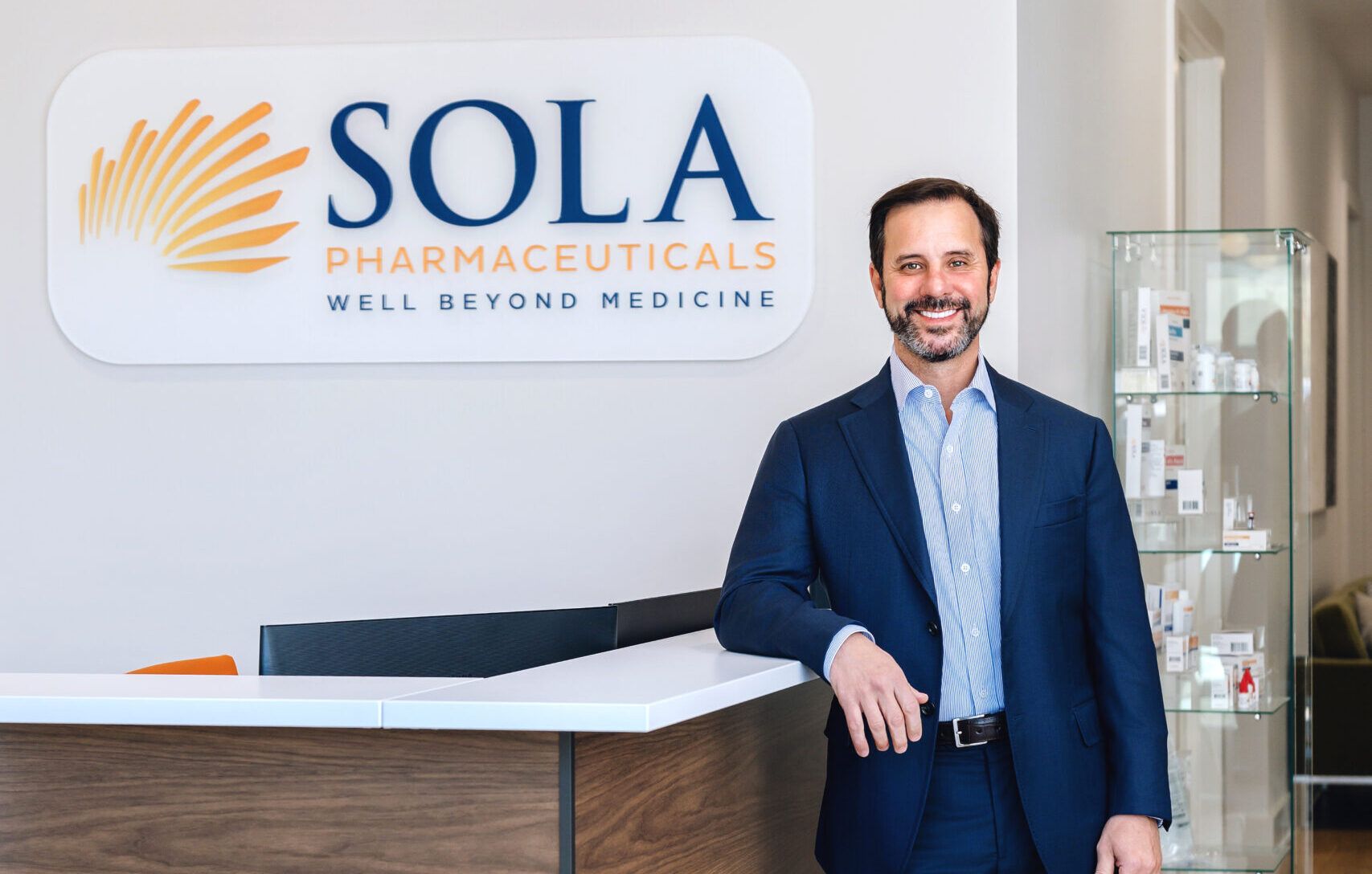
SOLA’s pursuit of excellence is also guided by something loftier, says founder and CEO Keith LaNasa.

“At the end of the day, what the effort here is about is getting these products to patients,” he says.

LaNasa launched the company as a self-funded startup in 2014. It’s grown to produce a range of mostly generic prescription and over-the-counter products, including extended topical medications such as creams, ointments, gels, lotions and patches. SOLA’s drugs are sold to nationwide pharmacies through major distribution channels from its Baton Rouge FDA-approved, cGMP-certified and FDA drug supply chain-compliant headquarters and distribution center.

The company’s business model is built on scooping up generic drugs once the patent protections for their branded equivalents expire. One of the main ways it stays profitable is by working with FDA-approved contract manufacturing organizations, or CMOs, to produce drugs, a trend in the industry since 2012, LaNasa says. This approach helps companies like SOLA avoid the exorbitant costs of building manufacturing facilities for each drug type, a massive investment that is required before FDA approval is even secured or the first products roll off an assembly line.

By working with CMOs and contract development and manufacturing organizations, or CDMOs, SOLA can affect product excellence while also staying nimble in what it chooses to sell. It’s not pigeonholed by certain categories of drug, LaNasa says.

“We’re able to very quickly target shortages and product lines that fit our margin requirements,” he says.

The strategy continues to serve SOLA well, but the company is now in a stage where it sees upside in building its own transdermal patch manufacturing facility, an anticipated $15 million investment in Baton Rouge, where the company will remain. SOLA currently produces between 30% to 40% of the patches in the U.S. market.

“We build so many patches, that it makes sense for us to invest in bringing the technology here,” LaNasa says.

The project is three years in the making, but it will benefit from a new political climate that prioritizes domestic manufacturing. Most patches—like most drugs—are produced internationally.

Profitability isn’t the company’s only success matrix. SOLA’s culture is infused with the philosophy that it’s OK to combine a strong bottom line with compassion.

Perhaps no better example exists than its success in lowering the cost of the drug teriflunomide, used to treat the progression of multiple sclerosis. The drug has cost patients in the U.S. up to $10,000 a month, according to the National Multiple Sclerosis Society.

“We were able to secure the ‘first to file,’ meaning we were the first authorized generic by the FDA,” LaNasa says.

SOLA opted to lower the cost of the drug dramatically, and other generic manufacturers followed suit. Patients can now buy the drug for around $400 a year, LaNasa says.

“When we dropped the price, some people came to me and said, ‘What are you doing? You’re crazy.’”

LaNasa says it’s paid off. “That’s afforded us a lot of opportunity. I think it’s driven a lot of people to say, ‘Hey, I want to do business with you.’”

The company’s custom technology enables its 12-person team to do the work of 40 to 50 people, LaNasa says. The system includes advanced forecasting tools, automated invoicing and quality control.

Another important component is rapid-fire serial number tracking, or serialization, an essential function of drug manufacturers who must be able to trace the provenance and distribution of a particular product. SOLA can track the location of a drug via its serial number in about three minutes, a fraction of the time it takes its industry peers.

LaNasa and his team also prioritize employee training with a program called SOLA University, which has helped build a competent workforce that can handle complex tasks and adapt to new challenges, he says. Employees are cross-trained to understand all systems throughout the company.

“When we hire, we pay attention to IQ, EQ and FQ,” says LaNasa, referring to intelligence, emotional and failure quotient, or the ability to get back in the saddle. “Nothing fills my bucket more than to watch our employees and know that they really know what they’re talking about.”


Read about the other 2026 Business Awards & Hall of Fame honorees.

Exit mobile version