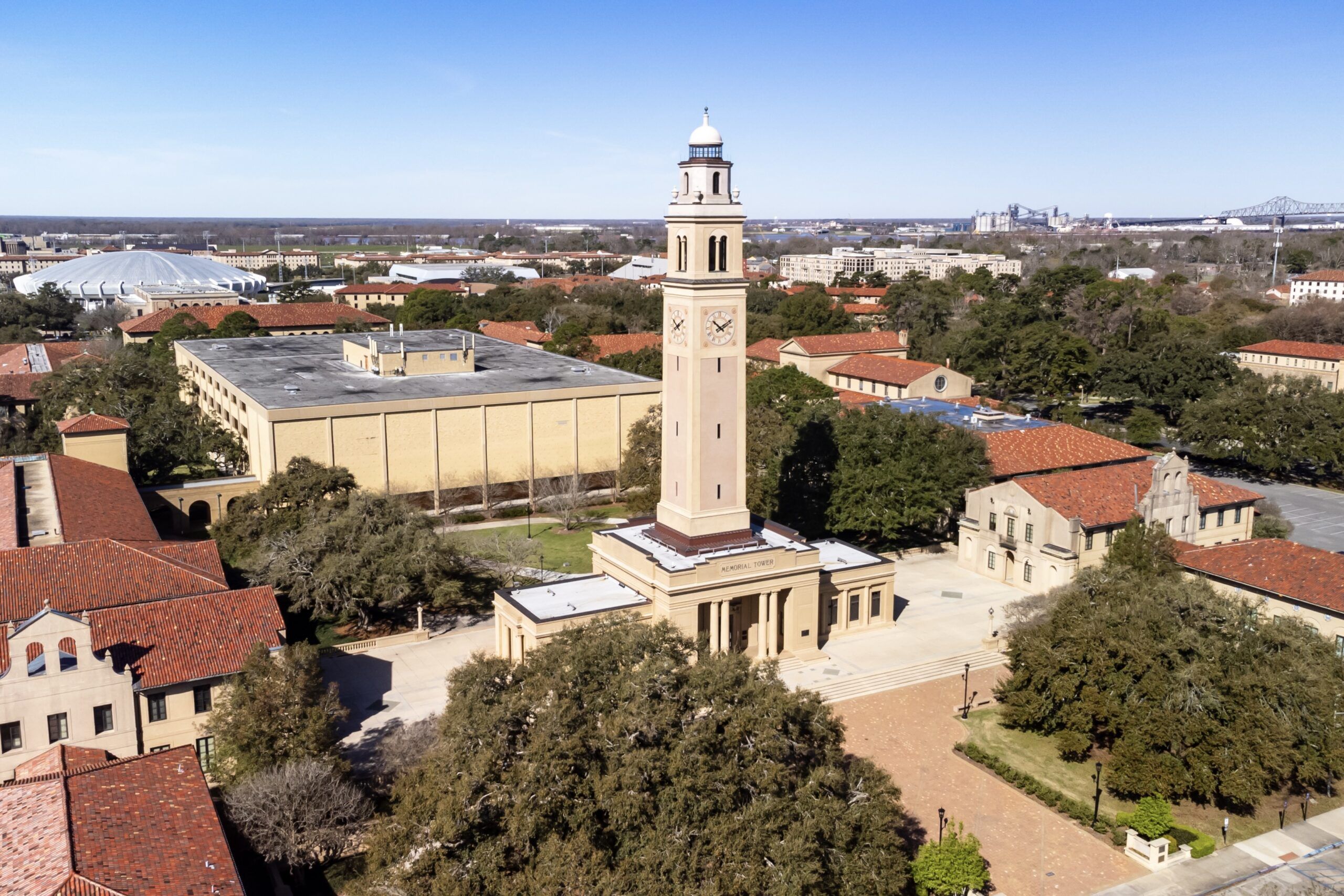
The LSU Board of Supervisors on Thursday approved a series of organizational changes that reshape the LSU System’s leadership structure, reinforce presidential oversight and lay the groundwork for a more unified and ambitious research enterprise.
The board also approved new contracts for President Wade Rousse and Executive Vice President and Chancellor James T. Dalton.
As part of the reorganization, all chancellors will report directly to Rousse, who will also oversee athletics, external relations—including government relations—and the University Laboratory School. The board also reinstated the chancellor position at the flagship campus.
The new structure designates the president as the strategic leader of LSU’s statewide mission, aligning academic oversight, system operations and external engagement in a unified direction.
“These changes give the LSU System the clarity and unity required to move forward together,” Rousse said in a prepared statement. “When our campuses, our leaders, and our research engines are aligned, we are better positioned to serve Louisiana and to show the country what LSU is capable of.”
Unified research foundation
The board also approved a significant realignment of LSU’s research operations, a move long seen as central to elevating Louisiana’s standing among top public research institutions.
Historically, LSU’s research output has been split across five campuses—the flagship, the AgCenter, Pennington Biomedical Research Center, LSU Health New Orleans and LSU Health Shreveport. Despite each site’s individual strengths, their productivity has not appeared collectively in national rankings because expenditures were reported separately.
In the National Science Foundation’s 2023 higher education research and development report, LSU—including the AgCenter and Pennington—ranked 83rd nationally with $384 million in research expenditures. LSU Health New Orleans reported $68 million, ranking 200th, while LSU Health Shreveport reported $36 million, ranking 249th. Combined, LSU produced $488 million in research—roughly equivalent to the nation’s 69th-ranked public research university.
Under the new structure, these units will operate as a single flagship university under Dalton’s leadership.
LSU’s model now mirrors that of several top public research institutions, including Wisconsin, Ohio State, Maryland, Florida, Penn State, Arizona, Illinois and Georgia.
“We have the talent, infrastructure and ambition to be a leader in research,” Dalton said. “A unified research structure better positions us to successfully compete for major grants, attract exceptional faculty, and expand the discoveries that improve life across this state. It gives Louisiana the visibility and momentum it has long deserved.”