Home Ascension Straight Talk with Hancock Whitney Ascension Market President Kevin Schexnayder

Straight Talk with Hancock Whitney Ascension Market President Kevin Schexnayder

As industrial investment and population growth continue to reshape Ascension Parish, local banks are playing an increasingly critical role in supporting businesses and developers as they navigate that expansion. In this Q&A, Kevin Schexnayder, Ascension and Livingston market president for Hancock Whitney Bank, discusses trends in commercial lending, the parish’s economic trajectory, and how financial institutions are positioning themselves to meet rising demand across sectors—from industrial support services to residential and mixed-use development.

What trends are you seeing in commercial lending activity in Ascension Parish, particularly among small and mid-sized businesses?

We are seeing steady demand for commercial lending across Ascension Parish, particularly among small- and mid-sized businesses positioning themselves to support the parish’s continued growth. A lot of that activity is tied to companies investing in equipment, expanding facilities, increasing working capital, and investing in their people through training and workforce development to keep up with rising demand. Businesses that support industrial projects are especially active right now. They are making investments in people, equipment, and infrastructure to handle larger volumes of work, longer project pipelines, and more complex job requirements. At the same time, we are seeing new businesses enter the market to capitalize on that growth, creating additional lending opportunities. Another trend is a greater focus on liquidity and flexibility. Even with strong demand, many business owners are being more deliberate in how they structure debt, manage cash flow, and plan for potential shifts in the economic environment.

How would you characterize the current economic trajectory of Ascension Parish compared to the broader Capital Region?

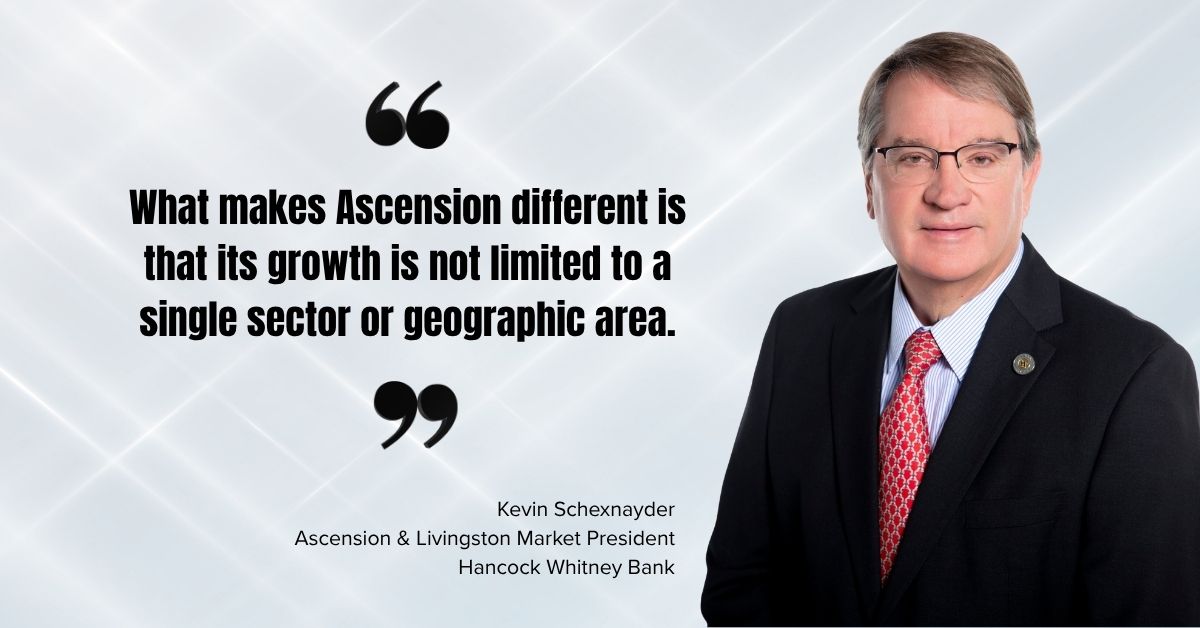
The Capital Region as a whole has positive momentum. Still, Ascension stands out because it is benefiting from both large-scale industrial investment and continued residential and commercial expansion at the same time. Major announced projects tied to the RiverPlex MegaPark and surrounding industrial corridor represent multiple billions of dollars in investment, with companies like CF Industries, Hyundai Steel, and Linde all contributing to that growth. That level of activity is helping position the parish as a major driver of regional momentum. What makes Ascension different is that its growth is not limited to a single sector or geographic area. Demand in several areas continues to outpace available inventory, which reinforces how active the market remains. From a banking perspective, that creates a more balanced and sustainable growth story. Ascension is not just participating in the Capital Region economy. In many ways, it is helping shape where the region is headed next.

With continued industrial expansion on the parish’s west side, how is Hancock Whitney Bank positioning itself to support that growth?

Hancock Whitney is staying closely connected to the businesses and developers driving that growth. As activity continues to expand throughout Ascension Parish, our focus is on being proactive rather than reactive, making sure we understand where our clients are headed and what they will need to support that growth. Our teams, across retail banking, wholesale banking, and wealth, are consistently engaged in the community to stay aware of opportunities coming into the market. We maintain a collaborative approach, which allows us to bring the right people together to support clients’ immediate needs while also anticipating what comes next. Many of these projects are complex and having a local team with different specialties working together allows us to support clients across multiple areas. We also maintain strong support throughout our footprint, ensuring that leadership and key decision-makers are present in each market and closely connected to what is happening on the ground. We are continuing to invest in our team by adding associates to support the growth we are seeing across the Capital Region. The opportunity in Ascension Parish is significant, but it is important to make sure that growth is responsible and well-structured. That approach allows us to support clients as they expand while also helping position them for long-term success.

Illustration: iStock.com/ollo

Are you seeing increased demand for construction and development financing tied to residential and mixed-use projects in Ascension?

Yes, we are seeing increased demand, particularly as population growth continues to drive the need for additional housing and supporting commercial development. Ascension Parish has remained an attractive place to live and that is translating into continued activity on the residential side, along with interest in mixed-use projects that bring together housing, retail, and services. A lot of the activity is centered around keeping pace with growth. Developers are looking for opportunities to meet demand, whether that is through new subdivisions, multifamily projects, or developments that create more complete communities. Projects are being approached with greater planning and consideration than they were a few years ago. Developers are paying close attention to costs, timelines, and overall project viability, especially in the current rate environment. There is still strong interest in moving projects forward, but it is being balanced with a more measured approach.

How does workforce growth and population migration into Ascension influence your bank’s strategy in the market?

It is an exciting time to be in the Capital Region, especially in Ascension Parish. The population growth we are seeing alongside the economic expansion has created both opportunities and challenges that many of us would not have anticipated a few years ago. That growth is showing up across housing, infrastructure, and the types of businesses entering the market, all of which are contributing to the overall momentum in the parish. From a banking standpoint, workforce growth and population migration are two of the biggest drivers behind the activity we are seeing today. As more people move into the area, it creates demand for housing and services, which in turn drives additional business activity. That growth influences our approach by requiring us to stay closely connected to the market and be prepared to support clients at different stages of that expansion. On the consumer side, we are seeing continued demand for home lending and everyday banking relationships, while on the business side, we are working with companies that are expanding to meet that demand through commercial real estate, working capital, equipment financing, and other financing needs. It also reinforces the importance of staying engaged in the community and understanding where growth is occurring, how quickly it is happening, and what types of businesses are emerging. 

Looking ahead, what are the biggest risks or opportunities you see for Ascension Parish’s economy over the next 12 to 24 months?

Ascension Parish has significant opportunities ahead over the next 12 to 24 months, largely driven by continued industrial expansion and the population growth that follows. One of the biggest opportunities is the ability to sustain that growth over time. With multiple large projects underway and others still being considered, there is a real opportunity for Ascension to continue building on its position as a key economic driver within the Capital Region. If that growth is handled well, it can create long-term benefits for both businesses and residents. Some of the risks are tied to how quickly that growth is happening. Infrastructure, housing supply, and workforce availability all have to keep pace. If any of those areas fall behind, it can create pressure points that make it more difficult for businesses to operate efficiently and for the parish to capture the benefit of that growth fully. There is also some uncertainty tied to broader economic factors, including interest rates, supply chain dynamics, and geopolitical events. While those have not significantly slowed activity to this point, they are still areas that businesses are paying attention to as they make decisions. The focus moving forward is making sure that growth is managed responsibly in a way that supports long-term success and creates a balanced environment for continued investment for years to come.


Get access to all of Ascension Business Report‘s content. Connect with Ascension Business Report News Editor Jordan Arceneaux to recommend stories or provide feedback.

Exit mobile version