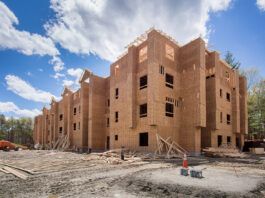
States and cities across the U.S. are increasingly loosening building and fire code requirements in an effort to reduce construction costs and expand housing supply, especially for affordable multifamily projects, Louisiana Illuminator reports.
A major focus is allowing “single-stairway” apartment buildings, typically four to six stories tall with one exit instead of two. Supporters say this design can make better use of small or irregular urban lots, lower construction costs and speed up housing development.
Similar cost-cutting changes are also being adopted in other areas, including fewer code update cycles, relaxed electrical safety rules, reduced fire protection requirements in some cases and changes to elevator standards.
Policy approaches vary widely by state. Some allow single-stair buildings statewide, others let local governments opt in or out, and some are still in study phases. Several states, including Colorado, Texas, Idaho and Washington, have recently passed laws expanding or permitting such buildings under specific safety conditions like sprinklers and smoke detection.
At the federal and model-code level, updates under consideration could further expand acceptance of single-stair designs.
Supporters argue that modern building safety systems—sprinklers, alarms, fire-rated materials and protected stairwells—can make these buildings as safe as traditional designs. They also point to data from cities that already allow them, suggesting fire death rates are comparable to other residential buildings.
Critics, particularly fire safety officials and some engineers, warn that removing redundancies like a second staircase increases risk during emergencies, complicates evacuation and forces firefighters to use the same route as residents. They argue that many existing codes were adopted after past tragedies and should not be weakened without strong evidence.
Beyond stair design, states are also adjusting electrical and elevator codes to reduce costs, though opponents say the savings are often modest compared to potential safety trade-offs. Some states are even slowing the frequency of building code updates, raising concerns that safety improvements may be delayed.
Louisiana Illuminator has the full story.